Showing posts with label Enviornmental. Show all posts

Thursday, March 16, 2017

Snow Safety Tips


With the dumping of 30+ inches of snow in some areas from "STELLA" here are some important safety tips:
 
·        Shoveling: take breaks and make sure to dress warm to avoid frostbite – know your limits!

·        Snow blowers: do NOT try to clear obstructions from a running machine

·        Snowy roof tops:  use a long pole snow removal device instead of climbing up a ladder

·        Preventing slips: wear proper footwear, and take smaller penguin style steps

·        Winter driving: slow down, and keep a good distance between you and the other cars, be aware!

·        Emergency kit: it’s a good time to check what’s in your kit, or create one
 

You can read more detail here, courtesy of OSHA:


Friday, September 9, 2016

Walk, Bike, and Roll

Complete Street with multi-use lane
What do sidewalks, crosswalks, bike lanes and paved shoulders have in common?  They all help to make our streets complete! If you have never heard of Complete Streets before, you are not alone. Complete Streets is a fancy term used to describe streets and roadways that are safe for all users – walkers, bikers, the elderly, the handicap, and even children.
If you have driven, walked, or biked down Margaret Street in Plattsburgh you may have noticed that there are now sidewalks, bike lanes and crosswalks with flashing signs. All of these elements make it safer to walk, bike, roll and drive. Complete Streets also encourage us to be more physically active as a community – something we can all use more of!

Not complete - no shoulder or sidewalk
Complete Streets are becoming an increasingly common practice. Today, there are over 85 villages, towns and/or cities, and 9 counties in New York State that have Complete Streets policies or resolutions. For more information about Complete Streets and to find out if your Town or County has a Complete Streets Policy visit: https://www.dot.ny.gov/programs/completestreets


Wednesday, August 31, 2016

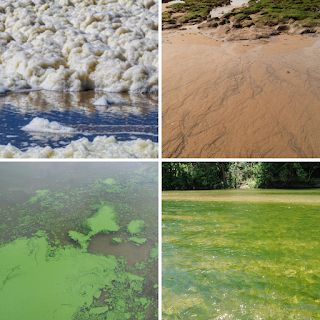
What in the World is Blue-Green Algae?


We’ve all seen the news. Beaches closed during the nicest days because of blue-green algae.

So WHAT is it?
 
The NYS Department of Environmental Conservation says that blue-green algae is found in freshwater lakes and ponds and can be harmful under certain conditions. A water sample is usually necessary to determine if there is a level of harmful toxins in the blooms. It can be toxic to humans, pets, fish, and other organisms. These nerve, liver, and skin toxins can sicken people, pets, or livestock if consumed or ingested in large quantities. They can also cause rashes or other allergic reactions. 
 
What causes Harmful Blooms?
Blooms may be triggered by a combination of water and environmental conditions, including:
·        excess nutrients (phosphorus and nitrogen)
·        sunlight
·        low-water or low-flow conditions
·        calm water
·        warmer temperatures
·        upwellings

You and your pets should stay away if you ever see an announcement about Blue-Green Algae in a lake or pond that you visit often, until you hear that it’s safe.

(For more information, visit: http://www.dec.ny.gov/chemical/77118.html)

Monday, July 11, 2016

Nice Day for a Walk


The song “It’s a Sunshine Day” by Steve McCarthy, made famous by the Brady Bunch sums up my feelings as I write this. It’s ok if you start to sing.
  I think I'll go for a walk outside now
 The summer sun's callin' my name
 (I hear ya now)
 I just can't stay inside all day
 I gotta get out, get me some of those rays

 Everybody's smilin', sunshine day
 Everybody's laughin', sunshine day
 Everybody seems so happy today
 It's a sunshine day

Now that the North Country is finally getting some “sunshine days”, it’s time to take a walk outside. We are lucky to have many trails and areas to hike. The Clinton County Health Department has developed a Walking Trails Map to guide your travels. It includes locations, descriptions and pictures of the following trails:

·        Point Au Roche State Park
·        Terry J. Gordon Recreational Path
·        Saranac River Trail
·        Cadyville Recreation Park
·        Saranac New Land Trust
·        Little Au Sable River Trail
·        Silver Lake Bog Trail

Maps have been distributed to town and village offices, the Chamber of Commerce, through the Clinton, Essex, Franklin Library System. You can also find them at the YMCA, the City of Plattsburgh Recreation Center, the Clinton County Health Department, and other locations in Clinton County. You may also call the Health Department’s Division of Health Planning and Promotion at (518) 565-4993 to request a copy. We hope this resource will encourage you to explore a new trail, walk more and have a “sunshine day!”

Thursday, June 23, 2016

Buzzy Buggy Summers

With outdoor summer fun may come some unwelcome guests: mosquitoes!

Around the North Country those creatures are far from popular. CCHD even blogged about how pesky they were and how to reduce the potential breeding grounds around your house last year.

This year, many people's concerns are on Zika, West Nile, EEE, and other illnesses that are spread by mosquitoes. One way to protect yourself and your family is through using an insect repellent on skin when outdoors. Repellents containing 20% or more DEET (N, N-diethyl-m-toluamide) can protect up to several hours. Always follow product instructions. Parents should apply this product to their children, avoiding the hands, eyes, and mouth.

For detailed information about using DEET on children, see recommendations from the American Academy of Pediatrics. For more DEET info, check out the CDCs information sheet.

Enjoy that outdoor summer fun - safely, and without those irritating mosquitoes!

Monday, May 9, 2016

Learning About Zika


Late last winter I was reading The Washington Post about a virus in Brazil that was linked to unprecedented cases of microcephaly. Microcephaly is a condition in which the brain does not develop properly leading to children born with small heads. The virus had a short name, Zika.

I hadn’t heard of the virus before so I asked about it at my place of work, the Clinton County Health Department. As a Public Health Educator, I like to investigate new problems that may affect public health. Soon after, the name Zika was all over the media and the situation became a worldwide concern.

Unfortunately, the quick spread of the virus had some people spreading misinformation about the virus. It is hard to wait for scientific proof of an emerging health threat. Some of the things we do know are:
·         Zika is not spread person to person but by a specific species of mosquito.
·         There are no documented cases of Zika being spread by mosquitos in the US; however, there are 426 current travel related cases.
·         The greatest known risk of Zika is to the fetus of a pregnant woman who contracts the virus.
·         Zika can be spread sexually.
·         Pregnant women and women of childbearing age with sex partners that have been in areas of Zika transmission should use condoms correctly during all vaginal, anal, or oral sex or abstain.
·         Zika can be passed to a fetus during pregnancy and around the time of birth.
·         Zika is a cause of microcephaly; small heads in infants and other fetal brain defects.
·         The Centers for Disease Control and Prevention (CDC), is investigating the link between Zika and Guillain-Barre Syndrome (GBS). GBS is a disorder in which a person’s immune system damages nerve cells and can cause muscle weakness and paralysis.
·         There is no vaccine for Zika.
·         Zika is spread by the aedes aegypti mosquito but the aedes albopictus, found in NYS, has the potential to spread the disease as well.
The best way to prevent the disease is to protect yourself and family from the bite of mosquitos. To accomplish this:
·         Wear light colored long sleeve shirts and pants.
·         Make sure windows and doors have screens in good repair.
·         Use EPA registered repellant for exposed skin and permethrin for clothing.
·         Eliminate breeding sites. Empty all water from outdoor containers, and clean up gutters.
·         In some cases of standing water, chemical dunks may be useful.
Trusted sources of information:

Friday, April 29, 2016

Drinking Water Awareness Week

Do you know where your water comes from?  The average American family uses more than 300 gallons of water per day at home, yet only 23% of Americans know where their water comes from.  The American Water Works Association has designated May 1 -7 as Drinking Water Awareness Week, with the 2016 theme being “Your Water: to know it is to love it.”

So, how do you ‘get to know your water’?  First, you can start by understanding that water and wastewater services are a 24/7/365 operation.  The Clinton County Health Department regulates approximately 210 Public Water Systems to ensure safe drinking water is provided to the public. They are responsible for monitoring more than 100 contaminants on a regular basis, staying in compliance with the U.S. Environmental Protection Agency and the New York State Department of Health standards for drinking water. 

Each water system is maintained by a Water Operator, working hard to ensure that the water you drink is safe.  One such operator is Jamie Giroux, Water Operator at Saranac Central School District.  When asked why what he does is important to community health, he stated, “The process of supplying good, safe drinking water is very demanding and rewarding.  I always strive to provide only the highest quality of domestic drinking water.”  Part of ‘getting to know your water’ is most definitely understanding that there are many ‘real’ people working diligently every day to ensure that when you turn on your tap, safe, drinkable water comes out.  The Clinton County Health Department thanks Jamie Giroux and all of the other Water Operators out there for the excellent work they do!

Thursday, April 21, 2016

Earth Day and Public Health


Earth Day started as a day of education about environmental issues. Founded in 1970 by Senator Gaylord Nelson, the movement began as a way to gain national attention to environmental causes. In 1990 Earth Day went global with over  140 countries participating. As Earth Day approaches its 50th anniversary, an ambitious goal has been set.  The goal is to plant 7.8 million trees.
Why trees?
·         Trees clean the air- They absorb CO2, odors and pollutant gases by trapping them in their bark and leaves.

·         Trees conserve energy- When placed around your home can cut summer air conditioning needs. By reducing the energy demand, we reduce carbon dioxide and pollution emissions from power plants.

·         Trees help communities- Trees provide a habitat for animals, produce food that feed people, muffle sounds and can provide fuel for our homes.
The official Earth Day is April 22, 2016. Join your family and friends and plant some trees.

Monday, March 21, 2016

Spring Cleaning? What about those Smoke Detectors?


Here is a smoke detector which is over 10 years old and the battery is missing.  The resident didn't realize the battery wasn't in the smoke detector. 
 
Over time the battery compartments on smoke detectors become worn causing batteries to not fit properly, preventing proper contact to work. 
 
Dust accumulation can also hinder a smoke detector from working properly.  Smoke detectors should always be maintained by changing the batteries every six months, even if they're not beeping.  Batteries wear down and become weak causing them to not function properly if they need to alert individuals to a potential fire. 
 
When you're spring cleaning - think of the safety products in your home: smoke detectors, fire extinguishers, carbon monoxide detectors, first aid kits, and flashlights. Be sure these are well maintained, and easily accessible.
 
The Clinton County Health Department has a program that can help Clinton County residents with a free, confidential assessment of your home. Call the Healthy Neighborhoods Program today at 518-565-4870.

Tuesday, July 21, 2015

Down with Mosquitoes

Swat! Slap! Squash!

Aside from being a pesky addition to your outdoor fun, several mosquito species have been linked to carrying West Nile virus, an infection that can cause serious illness. There are 70 different species of mosquitoes in New York State, so how can we best avoid and reduce our exposure to mosquitoes?

Some mosquitos are most active between dusk and dawn when the air is calm, and that is when the females are most likely to bite. However, others will feed at any time of the day.

Some mosquitos lay their eggs in standing water around the home. They can develop in any standing water that remains more than four days. Weeds, tall grass and shrubbery provide an outdoor home for adult mosquitoes, which may also enter houses through unscreened windows and doors, or broken screens. Many kinds of mosquitoes will breed in discarded tires.


How can you reduce the number of mosquitos around your home?

·         Make sure all windows and doors have screens, and are kept repaired

·         Turn over plastic wading pools and wheelbarrows when not in use

·         Remove leaf debris, used tires, containers, pots of similar water-holding containers

HABs – Say Algae You Later!

Being a Clinton County native, summer notifications of harmful algal blooms (HABs) at local beaches are nothing new. Certain places in our ...