Showing posts with label Health. Show all posts

Sunday, June 27, 2021

Your One Stop Shop for Breastfeeding Support


Like any other expecting mom, my mother had to decide how she was going to feed me once I was born.  She told me that it was an extremely difficult decision to make because she worked full-time and didn’t know how she was going to balance everything. However, her provider explained that breastfeeding was not only a bonding experience but also the perfect balance of nutrients that her body would make specifically for me, her baby.

Nature's Way Baby Cafe (R)
With the support of my father, she made the decision to start exclusively breastfeeding.  A couple months
into our breastfeeding journey, I proved to be a very fussy baby.  My mother recalled how frustrating it sometimes was to have to reposition every time I was feeding or how expressing milk was difficult without a pump.  Through all the hurdles she faced, she continued to breastfeed until I was 18 months old.  And let me tell you, she would do it all again if she could.

If you are a breastfeeding mother, odds are you have found yourself in similar situations to what my mother had to face.  With access to the internet and an increasing number of community resources it is easier to search for information. But, sometimes you still cannot find what you are looking for and don’t know where to ask for help. That is where the Clinton County Breastfeeding Coalition comes in!

The Clinton County Breastfeeding Coalition is comprised of community organizations and local moms and meets once a month to promote and advocate for breastfeeding in our area. The coalition created and maintains the Clinton County Breastfeeding Referral Guide which is your one stop shop for evidenced based breastfeeding related help. They are also spearheading a social media campaign aimed to normalize breastfeeding while highlighting the ‘realness’ because, let’s be honest, it isn’t always rainbows and butterflies. You can expect to see one post per month on CCHD’s social media platforms from June through November 2021. You will be able to interact by posting pictures of you and your nursling(s) with #ThisIsHowWeNurse.

Example of the Clinton County Breastfeeding Coalition's Social Media Campaign 

Chances are, at some point each of us will know a mom who wants to breastfeed. Just like my mom’s doctor and my father did, I am challenging each of you to support and encourage that mom to reach her goals. Sharing this campaign on your social media is one small way you can contribute to a cultural shift in which we all view breastfeeding as normal, accepted and welcomed.


Alexandra Mesick

Public Health Educator

Division of Health Planning and Promotion 

Thursday, August 27, 2020

Back-to-School Tips for the COVID World

The start of every school year is an exciting, but scary time. Add in new reopening guidelines and health concerns about COVID-19, and many parents have found themselves at a loss. Is it safe to send my child back to school? Can I commit to remote learning? While I can’t tell you which option to choose, I can give you some easy tips to help your family with that transition. Routine is important for kids, start practicing now so they can have an easier first day later.

Tips for Traditional Learning

  •        Practice wearing a mask. Have your kids spend time each day wearing a mask while doing 
    everyday activities. Having trouble? Make a rule that they can’t use technology (watch tv, play on devices, play video games, etc.) unless they wear a mask. Chances are they want those privileges enough to comply. Pay attention to how often they touch or play with the mask. It defeats the purpose of a mask if they keep sticking their fingers inside! Be sure they know how to
    put it on and take it off properly, without spreading their germs all over. Make sure you have a few masks in the rotation. They need to be washed each day and you should always pack a backup.
  •     Teach them to wash hands properly. Teach kids the five easy steps for handwashing—wet, lather, scrub, rinse and dry—and the key times to wash hands, such as after using the bathroom or before eating. Find ways to make it fun, like making up your own handwashing song or turning it into a game. Try the A, B, C’s or Row Row Row your boat. Proper handwashing includes 20 seconds of scrubbing, be sure the song you choose last at least that long.
  •     Practice social distancing. Help your children learn what being 6 feet apart really means. Practice staying 6 feet apart while doing everyday activities.
  •     Teach them how to open snacks and drinks. The more help your child needs to open things, the more hands will be touching their food. Practice lunch time at home so they can learn how to open items that might be packed in their lunch box.
  •     Pack a water bottle. Water fountains won’t be an option this year, so consider packing a full water bottle every day.
  •     Stay flexible. Schools are doing their very best to be prepared for every scenario, but change is inevitable. New things are learned every day and practice makes perfect. New protocols will be added or tweaked as needed once we start to learn what works best.

Tips for Remote Learning

  •     Stick to a routine. Wake up, eat breakfast, and get dressed for school – the only difference in their morning routine should be the commute to their desk instead of their school. If you don’t set a schedule for learning it will be difficult to tear kids away from toys and fun and it may lead to arguments and frustration. Kids are used to a set schedule at school, they do it for their teachers and they will do it for you too! You just have to commit to having a structured day, focused on getting the learning done.
  •     Dedicate a learning space. Set up an area in your home that you use only for learning. Make sure the temptations of play time, tv, and tablets are far away so the focus can be on learning. Set up your supplies just like their desk would be set up at school. Setting their space up can help them be excited to start learning again, a flashy new pencil never hurts either!

  •     Sit in the best position for learning. Be sure the space you use is right for your child. Make sure screens are at eye-level and kids are sitting up straight. Lounging in the chair or on the couch isn’t conducive to learning. Have a fidgety kid? Try using the “prone” position (laying on the floor on their bellies.) This flexible seating option can sometimes help students focus when they are having a rough day.

No matter which option you choose, remember that your kids are looking to you for guidance. Be positive about the experience no matter how you are feeling. If you show them your apprehension, they are likely to be scared too. You’re doing great and we will get through this together!

To learn more, check out the additional resources the Centers for Disease Control and Prevention (CDC) has for back to school planning.

Krissy Flynn

Elementary School Teacher

Friday, May 29, 2020

In the Major League – CCHD’s COVID-19 Emergency Response


About two years ago, I transferred to the Clinton County Health Department (CCHD) after 8 years as Clinton County’s Recreation Director. Functioning in an emergency response for the first time, and being a former collegiate softball player, I see lots of similarities between softball teams and public health response teams.

Any time you start with a new team there’s training. CCHD offers lots of training, including ICS, or Incident Command System. Every new employee starts with ICS 100 and ICS 200 level training along with NIMS (National Incident Management System). ICS/NIMS training ensures that CCHD staff can function effectively as a team in the event of an emergency – kind of like preseason training. It also ensures that we are able to speak the same emergency management language as other teams, like Law Enforcement and Emergency Services personnel. We complete drills (think scrimmages) frequently to practice these principles in simulated events.

As part of a Public Health team, I always understood the possibility of being called up to the big leagues (like a pandemic). Fast forward to the 2020 Spring Season where I’m playing in the championship game against COVID-19!

Behind every successful team is good coach. In a public health crisis such as this pandemic, our coach, aka Incident Commander, is Clinton County’s Director of Public Health. Several Section Chiefs act as assistant coaches responsible for certain aspects of the game/incident. Branch Leaders and Division Supervisors oversee the work assignments of players in their section. The Incident Commander and Section Chiefs, along with several liaisons and the incident’s public information staff work together to develop a strategy but it is the Incident Commander who approves the plan for each operational period (game). The team carries out the plan and the ICS team has a lot of different players, like a softball team.

Planning Section Chief
during pre-shift briefing.
There is a Safety Officer. For this incident, the safety officer is a member of CCHD’s Environmental Health and Safety Division. She assesses safety in all aspects of our response – from large population-based safety concerns to smaller internal safety issues, like the time our office was using several types of
disinfecting products that should not have been mixed. Thank-you safety officer!

Organization is key to a good emergency response. The incident’s Planning Section Chief facilitates weekly and daily briefings, as well as command and general staff, tactics, and planning meetings. Meetings stay on track under her guidance. A written plan with specific objectives is generated for each operational period.

Clinton County’s Office of Emergency Services (OES) has been handling logistics. They are connected to the NYS Office of Emergency Services and work to ensure that Clinton County has the supplies it needs. They’ve been thrown a few curveballs but have kept the flow of PPE (personal protective equipment), testing materials, etc. coming.

Public Information Officers (PIO) manage communications creating press releases, coordinating video events, and monitoring social media. I’ve been rotated into a PIO position several times during this COVID-19 pandemic as a member of the Public Information & Education Team. We have fielded more than 1700 phone calls from the public to date.

Several liaisons help us reach out to other teams. CCHD’s Public Health Emergency Preparedness Coordinator acts as a liaison to UVHN-CVPH and the Town of Plattsburgh Supervisor is filling the role of Local Government Liaison in this incident.

I&Q Team getting ready
to deliver quarantine
orders.
Last but certainly not least is the I&Q Team (isolation and quarantine). They’re like outfielders. They cover a lot of ground, are extremely reliable, and are counted on to pull out the occasional diving catch. The I&Q Team are the folks who do the contact tracing required for a communicable illness like COVID-19. They determine who each positive case has been in contact with and issue
isolation and quarantine orders as needed. They communicate daily with those in isolation and quarantine. Not only do they check in on symptoms, they make sure these individuals have essentials (like food and safe housing), and check on their mental health, often with an assist from the Human Services Branch.

In addition to our starters, we also have a strong bench waiting to jump in when needed. Many CCHD staff members are functioning under a COOP (Continuation of Operations Plan), doing typical day-to-day work with some modifications, but constantly keeping up with new guidance and training so that they are ready to pitch in and help out at a moment’s notice.

As far as teams go, and I’ve been on a lot of them, this one is a World Series kind of team.

Molly Flynn
Senior Public Health Educator
Clinton County Health Department

Monday, January 13, 2020

Ice, Ice, Baby!


Whoa. Mother Nature showed us some fury this weekend…wind, rain, freezing temperatures, ice, more wind, a little snow and oh, an earthquake too. Winter weather is in full swing and so are weather related injuries. 

All right stop. 

Collaborate and listen. 

First off, if you’re planning on doing any break-dancing I would suggest staying inside or it may end up more like a slip-n-slide. Once you’re done dancing I want to share with you some fool proof ways to keep both feet firmly on the ground.
  1. Keep your hands free, not in your pockets. This will allow you to brace yourself should you slip and fall.

  2. Wear proper shoes. I know heels and leather-soled shoes are more fashionable, but boots with rubber soles will help keep you upright. If it is really icy use ice cleats or creepers for added traction.
  3. Check before you step. Ice and slippery surfaces are not always easy to see. If you think an area may be slippery test the area without using the full weight of your body.
  4. Avoid carrying heavy loads when walking over areas packed with snow or ice.
  5. Don’t run across wet, icy or snow-filled surface. That is just asking for trouble.
  6. Use handrails, walls, door handles and other secure objects to brace yourself when stepping onto icy or snowy surfaces.
  7. Take short steps, with your feet pointed out slightly, like a penguin.
  8. Stay on cleared sidewalks or paths and keep your own driveway and sidewalk clear of snow and ice.
  9. Dress warm. When your body is cold your muscles are tense and that can affect your balance.
  10. Ask for help if you need it.
Remember, if the weather is bad and you don’t have to leave the house, stay put. Warm up a nice cup of tea and finish off the book that’s been sitting half-finished on your nightstand. Your errands will still be there tomorrow.

For more winter safety tips head on over to our 2019-2020 Winter Safety Guide.

Molly Flynn, Senior Public Health Educator 
KayLeigh Raville, Public Health Nutritionist 
Health Planning and Promotion Division 

Wednesday, August 14, 2019

Happenings at CCHD: Director of Public Health

John Kanoza, Director of Public Health 
After working for 14 years in the private sector as a consulting environmental engineer/hydrogeologist I decided it was time for a switch. I was looking to set aside the #1 goal of “making money for the company” in favor of helping people and communities. In September of 2002 I accepted the position of Director/Engineer of Environmental Health & Safety here at the Clinton County Health Department (CCHD) where I served for 15 years. Fast forward to 2017. Our previous Director of Public Health, Jerie Reid, announced she would be retiring in October 2017. She recommended that I consider applying for the position. The thought of this took me by surprise but I figured since we have a very solid and experienced department I could become a successful Director over time. And here I am!

Though I do miss the engineering and problem solving work that I did as Director/Engineer of the Environmental Health & Safety Division, I have found that my role as Director of Public Health also includes a variety of problem solving tasks (of a different nature, but problem solving none the less J).  As well as doing everything possible to network and expand our many public health objectives I sincerely enjoy my daily interaction with department staff.

So, what else do I do all day?
·         Check on and attend to specific division, program and department needs. Our department has 5 different divisions and over 20 different programs/grants...this is a never ending task.
·         Answer requests from our Board of Health and County Legislature.
·         Chip away at our Community Health Improvement Plan (CHIP) and Community Health Assessment (CHA)…see what I did there?
·         Protect residents from potential health harms. See an example here.

Our field of Public Health is no doubt very strong. Based on new and changing risks to public health, it appears very likely that the need for public health professionals will only increase in the future. Over the last 17 years, I have grown to enjoy focusing on the single BIG objective of keeping our residents and community healthy and safe every day.

John M. Kanoza, P.E., P.G.
Director of Public Health
Clinton County Health Department 

Friday, March 22, 2019

Spring…is that you?

Spring showers bring May flowers, but, combined with run-off from melting snow, they can also leave your private well water at risk for contamination. If you get your drinking water from a private well, here’s what you need to know.

In Clinton County, 28% of residents get their drinking water from private sources, such as wells, which we (the Health Department) do not oversee. To assist these residents, we began offering water testing to homeowners in 2017. With funding from the Clinton County Soil & Water Conservation District, this program was able to continue in 2018. Of the 109 samples collected from private wells in 2018, one-third (36%) tested positive for total coliform bacteria.

Why does it matter? Even if your water looks, smells and tastes fine, the only way to know if the water in your home is safe to drink is by testing it. Contaminants, such as bacteria, viruses or other pollutants, may be getting into your water. Coliform bacteria are found in the soil, in water that has been contaminated by surface water, and in human and animal wastes. If coliform bacteria are found in water, it means that the water system is not properly sealed, and may be unsafe. In other words, if total coliform bacteria can get into your water, then other bacteria that can make you ill may also be able to get into, or already be in, your water.

When should you test your drinking water? If you are not on public water and get your water from a private source, such as a well, we (the Clinton County Health Department) recommend testing your drinking water:
  • Yearly for bacteria and nitrates. 
  • At least every three years for other water contaminants to make sure nothing has changed. Long-term exposure to even low levels of contaminants can effect your health.
  • When you are expecting a baby.
  • When your water changes in smell, taste, or color. If this happens, drink bottled water and call us at 518-565-4870 to find out which tests you should do. 
  • If you perform any maintenance on your water system, like install a new pump, new water softener or make other repairs. Test for bacteria after disinfecting and flushing. 
  • If you put in a water treatment system to fix a problem. Test the treated water each year for that problem (contaminant) to ensure treatment is working properly.
    Drilled Well with a sanitary cap.

What else? Spring is also a good time to assess the condition of your private well. Start by checking the area around your well—keep it clean and free of animal waste and other pollution. Check your well’s cap—it should have a tight fitting sanitary (waterproof) cap in place. Make sure the well casing extends above ground level to prevent flooding of the well head. Lastly, keep possible sources of contamination, such as septic systems, manure storage piles, and fuel oil tanks, as far away from your well as possible.

If you are a homeowner and would like to have your well water sampled by CCHD, click here to sign up. We also created videos to help homeowners understand their wells, which are now available on our YouTube channel here.

Stay “well”!

Tim Simonette
Senior Public Health Sanitarian
Environmental Health & Safety Division


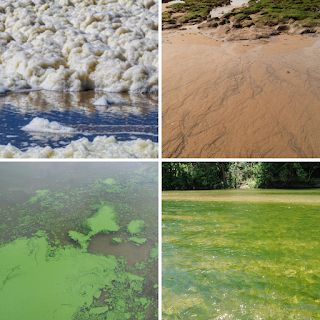
HABs – Say Algae You Later!

Being a Clinton County native, summer notifications of harmful algal blooms (HABs) at local beaches are nothing new. Certain places in our ...