Showing posts with label water. Show all posts

Thursday, July 21, 2022

HABs – Say Algae You Later!

Being a Clinton County native, summer notifications of harmful algal blooms (HABs) at local beaches are nothing new. Certain places in our County provide the perfect recipe for HABs – lots of sunlight; shallow, calm water; and warm temperatures. It is important to pay attention to these alerts or notifications to keep everyone safe and healthy. They can help decide which beaches to choose for a fun day on the water with your favorite humans and dogs.

What are they?

HABs are the rapid growth of cyanobacteria (sometimes referred to as blue-green algae). These blooms create toxins that can be harmful to people and animals. Coming in contact with, drinking (or swallowing), or even inhaling these toxins can make you very sick. Symptoms vary based on which cyanotoxin (a list I cannot pronounce) but can include: stomach pain, headache, muscle weakness, dizziness, vomiting, and diarrhea. If you think you might have symptoms caused by HABs, contact your healthcare provider and let them know you suspect it may be related to cyanobacteria.


Decided you don’t feel like wasting your summer days at home sick with any of the gross symptoms listed above? Me either! Here is what to look for before going in the water.

Figure 1

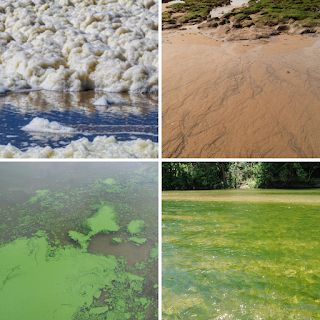
Don’t go in water that:

  • Smells bad.
  • Looks discolored.
  • Has foam, scum, algal mats, or paint-like streaks on the surface.
  • Has dead fish or other animals washed up   on the shore.

 See figure 1 for examples of blooms. Before you visit a local swimming area, find out if it has a  current blooms, or a history of blooms by clicking here.

You should also NEVER drink, prepare food, cook, or make ice with untreated surface water – whether   it has an active bloom or not. Do not fill pools with water directly from lakes, rivers, or ponds.

Figure 2

Don’t forget about your fur babies.

If they are anything like mine (say hi to Cami in figure 2), getting them to leave the beach is the hardest part of the day. Dogs can be at an increased risk of poisoning by cyanobacteria because of their general behaviors – swimming, drinking the water, and eating dead animals (like fish) found near the shore. Contact your veterinarian immediately if your pet seems sick after going in or near water. Some signs and symptoms include: excessive salivation, vomiting, fatigue, staggered walking, difficulty breathing, and convulsions.

Pets or kids raced ahead and went in the water before you saw something sketchy? Don’t panic. Rinse them, and yourself, off immediately with tap water from a sink, shower, hose, or outdoor spigot. Don’t let your pets lick their fur until they have been thoroughly rinsed.

If you come across a suspected bloom, it is important that you report it. For us that means visiting the DEC page here. Be sure to take a photo of the suspected bloom, you will attach it to your report.

Some blooms are short lived, dispersing in a few days. Others last longer. Best practice is to check the database before selecting which beach to visit. If you see something you don’t like, stay out and report it. Not sure what you are seeing? When in doubt, stay out!


Molly Flynn
Principal Public Health Educator
Division of Health Planning & Promotion

Sunday, September 15, 2019

How to Nourish Your Way to Victory!


Cooler weather, new school schedules, and back-to-school shopping. Aside from buying the coolest new clothes and shoes, have you thought about what you’ll buy to nourish your children’s bodies every day? Proper  nutrition is essential for all students, especially athletes. Pop quiz! What are the 5 food groups that everyone should include in their diets? If you answered protein, fruit, vegetable, dairy, and grains- you are right! Over the years I have learned how to change my diet so that I can perform at my absolute best in the gym. Here are a few tips on how you can help your kids do the same this year.


They say it’s the “most important meal of the day.” As it turns out, there is some truth behind this old saying and here are a few reasons why.

·         After a full night of rest and no eating, it’s important to refuel your empty tank to kick-start your day.

·         The brain uses 20% of the body’s total energy (or glucose, if we are getting technical). Just like an empty stomach early in the morning, the brain needs to be fed and recharged in order to prepare for the day ahead. If I miss breakfast, I feel foggy and find it hard to concentrate.

·         Starting the day with all 5 food groups puts you one step closer to reaching your MyPlate Plan.

Snacks:

Pre-workout or pre-game snacks should focus mainly on carbohydrates. That’s because they can be easily turned into energy (glucose) during exercise. Adding in some protein is also a good idea. Some of my favorite snacks are:

  •  Banana and a PB&J;
  • Yogurt with granola;
  • Apple with peanut (or any nut) butter.
Lunch and Dinner:

Lunch time is when energy (or, you guessed it, glucose) is put into storage to be used later. Dinner is the time to re-fuel after a hard practice or game. Eating right after exercising is the perfect way to help rebuild and recover muscles. For strong and lean muscles try these recipes:
  •         Turkey pinwheels (on whole wheat wraps) for a great game-day lunch;
  •      Tuna wraps to spice up your lunch and keep you full and focused;
  •      Mediterranean Orzo for a quick and satisfying post-game dinner.


Don’t forget about hydration!

The human body’s thirst reflex is 2 cups behind. This means that when someone feels thirsty, they are already dehydrated. It is important to drink water all day long. Follow these hydration tips on the day of a big game or practice:

·         Drink at least 1-2 cups of water every hour, 2-3 hours leading up to an event;
·         Drink 1 of water cup 15 minutes before the start of the event;
·         Drink ½ cup of water every 15 minutes during the event.
 
TRUE OR FALSE: The number one reason athletes underperform is because they don’t drink
enough water….TRUE! Our bodies can’t absorb more than 4 cups of water per hour but during intense exercise we can sweat out 4 or more cups per hour! Have your kids stay ahead of the game by keeping them hydrated all day long.


What about sports drinks?

You know, those brightly colored drinks full of carbohydrates, protein, electrolytes, and sugar? They are all the rage recently. You can find them in school vending machines, in coolers at sporting events, and in our refrigerators at home. But are sports drinks really needed? Probably not, except when exercising hard for over an hour. If this is the case, choose a sports drink with no more than 80 calories, minimal added sugar, and drink it in combination with water.
                                                              
Most importantly:

Have fun! Staying involved in sports is a great way for kids to stay active and build valuable life skills like leadership, confidence, and teamwork. Staying properly nourished and hydrated will make getting through practices and games all the more
enjoyable.


Emily Hutchins
Wellness Workdays Dietetic Intern
Division of Health Planning & Promotion

Friday, April 20, 2018

Does Your Well Need a Checkup?


Drinking water...turn on a faucet and it appears.  We drink, cook and clean with it.  Most of us don’t even think about whether it’s safe.  However, having access to clean, potable drinking water is one of the most important contributions to our community’s overall health.  

More than 1 billion people worldwide do not have access to safe drinking water.  The US is fortunate to have some of the safest public drinking water supplies in the world. 

The water we use daily can come to us in two very different ways: 
1.      Community (public) water system or
2.      Private water source, such as a well. 

Public water systems are regulated and must adhere to strict standards.  Private water sources, such as wells, are not regulated; individual homeowners are responsible for keeping their water safe. Approximately 28% of Clinton County residents have a private water source. If you are part of that 28%, here is how you can make sure your water is safe:


  • Ensure your well casing extends above ground level to prevent flooding of the well head.

  • Maximize the distance between your well and sources of contamination, such as septic systems, manure storage piles and fuel oil tanks, if possible.

Testing your water is key to knowing if your water is safe to drink.  Total coliform bacteria is naturally present in the environment and is used to determine the sanitary condition of a well.  Although total coliform bacteria by itself doesn’t usually make you sick, its presence tells you that other harmful bacteria, such as E.Coli, might be able to get into your well water too.  If results are positive for coliform bacteria, the well should be properly disinfected and retested.  

During spring certain weather conditions – such as melting snow, heavy rains and flooding – increase the chances of contaminates getting in your private well, making Spring the perfect time to do a well water ‘checkup’. 

Just like maintenance on your car or your home’s roof, you should always ensure your water source is being properly maintained.  For more information visit http://www.clintonhealth.org/wells. For concerns or questions about your water quality, contact the CCHD’s Environmental Health & Safety Division at 518-565-4870. 

Tim Simonette
Senior Public Health Sanitarian

HABs – Say Algae You Later!

Being a Clinton County native, summer notifications of harmful algal blooms (HABs) at local beaches are nothing new. Certain places in our ...