Showing posts with label lyme disease. Show all posts

Tuesday, June 14, 2022

Backyard Pests – They’re Starting to Tick Me Off!

With summer looking like it is here to stay I am ready to enjoy the fresh air and sunshine. But it seems like every time I try, I find myself swarmed by mosquitoes or picking ticks out of my dog’s fur. I’M BUGGING OUT! Luckily there are some fool-proof tips and tricks to help reduce your chances of getting bitten by both, and to save a little bit of sanity.

Let’s start with ticks. These creepy, crawly pin-heads (no, seriously they are the size of a pin head) spread diseases that make you sick. In our area, our biggest concern is Lyme disease, but we also see a few cases of Anaplasmosis and Rocky Mountain Spotted Fever each year. Cases of Lyme disease have increased 200% in Clinton County over the past 3 years. Grossed out? Me too. But we can take a few easy steps to avoid run-ins or bites from these guys.


1. 
Avoid areas they like. This includes grassy, bushy, brushy areas with tall grass and leaf litter.

2. Prepare for an encounter. You don’t need to be deep in the woods to get a tick bite; the run-in could happen in your own backyard. Before you head outdoors:

  • Apply an EPA-registered insect repellent.
  • Cover your skin as much as possible (enclosed shoes, long pants and shirts, tall socks).
  • Wear light colors. This makes spotting a tick easier.
  • Treat clothing with permethrin.

3. Remove any ticks before they have a chance to bite.

  • Do a tick check on your whole body using a mirror to see the tricky areas. See figure 1 to learn where to look on people and pets.
  • Take a shower as soon as you can. This will wash away any unattached ticks.
  •  Put the clothes you wore in the dryer for at least 10 minutes on high to kill any ticks.

Figure 1
Did all these things and still found a tick? I’ve been there! Don’t panic. Not all ticks are infected and your risk of Lyme disease decreases if you remove it within 24-36 hours. Click here to watch a video on the best way to remove ticks.

If you do find one of these pesky little dudes latched on, keep an eye on the bite site for a few weeks. If you develop a fever, chills, headache, rash, muscle or joint pain, or swollen glands within 30 days of your bite, contact your doctor. Be sure to let them know about your tick bite.


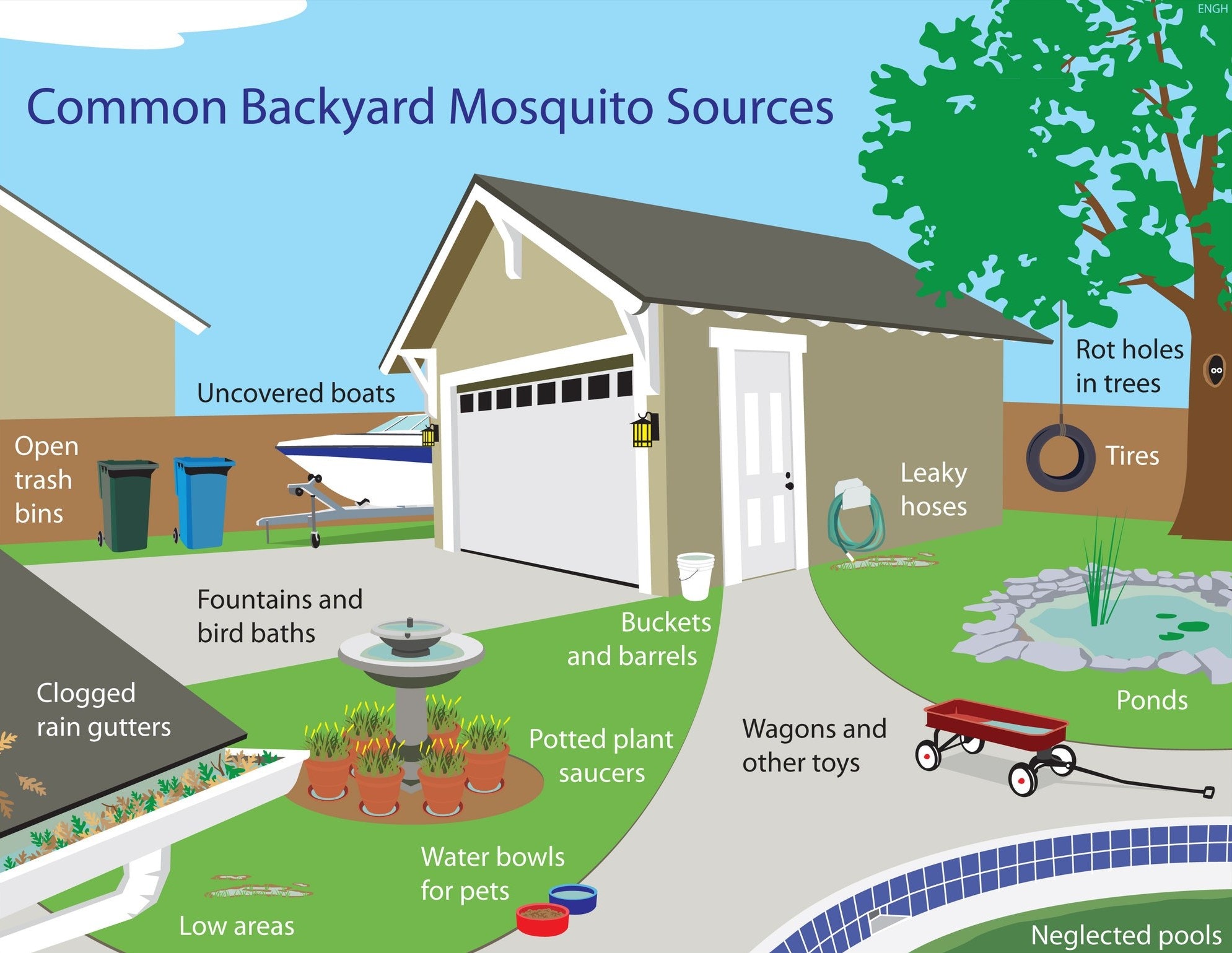
On to the most annoying creatures on the planet – mosquitoes! While they can carry diseases like West Nile Virus and Eastern Equine Encephalitis, in Clinton County they tend to be more of a nuisance than a disease spreader. If you seem to have an overabundance in your backyard, chances are you are to blame. How so? Mosquitoes lay their eggs in or near water. Then their babies grow-up in that water before flying away and biting. This entire process only takes about a week! So step one in reducing mosquitoes around your home is eliminating standing water at least weekly.

  • Figure 2
    Empty and scrub, turn over, cover, or throw away items holding water. Some examples include: tires, buckets, planters, toys, pools, birdbaths, flowerpots, and trash containers (see figure 2).
  • Make sure your gutters are draining properly.
  • Tightly cover any water storage containers – like buckets, cisterns and rain barrels. If it doesn’t have a lid, cover is with wire mesh.
  • Repair gaps or cracks in your septic tank. Cover open vent or plumbing pipes.
  • Drill holes in the bottom of recycling containers if you keep them outdoors.
·    When used as directed, insect repellents are the BEST protection.

  •       Always follow the product label instructions
  •       Reapply as directed.
  •      Do not spray on the skin under clothing.
  •      If using sunscreen AND insect repellent, apply sunscreen first, then the insect repellent.
  •      Store out of reach of children.
  •      Do not allow children to apply it themselves.
  •      Do not use it on children younger than 2 months.
  •      When applying to children, apply it to your hands first. Then rub it onto the child’s skin.

Don’t forget to keep the mosquitoes outside. Repair screens and keep doors closed.

Don’t let ticks and mosquitoes ruin your summer. Prepare for them, take steps to avoid them, and be ready to treat bites in case one or two get through. For more tips on having a safe and healthy summer, check out our Summer Safety Guide. Missed our Spring Safety Guide? No problem!

Molly Flynn

Principal Public Health Educator

Division of Health Planning & Promotion

Friday, June 4, 2021

Lyme Disease Cases Have Tripled in Clinton County…Here are 5 Ways to Prevent Tick Bites

As I am writing this, I have three children who are 8 years, 5 years, and almost 9 months old. Two things I always tell my children; I love you, and my job as your mom is to keep you safe! They tend to roll their eyes at the safety part (well the 8 year old and 5 year old do anywayJ). There are so many things to worry about as a parent but one thing I am extra cautious about are ticks. This is especially true from April-September (although don’t get too relaxed in late fall or winter, I found a tick crawling on my infant in mid-November).  

Ticks can carry a wide range of diseases. That is why I take extra care when it comes to not only
protecting my family but also my pets from these pesky creatures. Lyme disease (carried by the deer or black-legged tick) is the most common illness transmitted by ticks. Cases of Lyme disease have more than tripled in Clinton County since 2018, so it is more important than ever to be on the lookout for ticks.

5 Ways to Prevent Tick Bites:

1.  Know where ticks may be lurking

a. Ticks like grassy, bushy, or wooded areas but they also like to live on our pets.

b.   Always walk in the center of trails and avoid wooded and brushy areas with tall grass and leaf litter.

c.    You don’t need to be deep in the woods to get a tick bite, it can happen in our own backyards.

2. Apply insect repellent. This really deserves its own blog post, but here are a few quick tips to know before applying insect repellent on kids:

a.       Never apply insect repellent on infants younger than 2 months of age.

b.       Use Environmental Protection Agency (EPA) registered insect repellents containing, DEET, picaridin, IR3535, Oil of Lemon Eucalyptus (OLE), para-menthane-diolon (PMD), or 2-undecanone

                                                               i.      The American Academy of Pediatrics (AAP) recommends repellents should contain no more than 30% DEET when used on children (a higher concentration does not mean more protection).

                                                             ii.      Do not use products containing OLE or PMD on children under 3 years old.

                                                           iii.      Do not use products that combine DEET and sunscreen, although these seem like a great idea, it can actually reduce the effectiveness of the sunscreen and accidentally expose your kiddo to more DEET, because the sunscreen needs to be applied more often.

3. Dress for Success

a.       Treat clothing and gear with products containing 0.5% Permetherin.  It is important to note that this should only be applied to clothing, not to skin.

b.       Dress in light colors (it makes it easier to spot ticks), long pants, a lightweight long sleeved shirt, socks, and closed shoes before heading outdoors. Put hair in a ponytail and wear a broad brimmed hat.

4. After you come inside

a.       Check clothing, gear, and pets for ticks.

b.       Throw clothes in the dryer and tumble dry them on high heat for 10 minutes.

c.        Bathe within two hours after coming indoors.

5. Daily Tick Checks:

a.       Ticks are tiny and like to hide! Regardless if you or your kids have been outside or not, check everyone’s entire body for ticks daily, paying close attention to specific areas; under the arms, in and around the ears, inside belly button, back of the knees, in and around the hair, between the legs, and around the waist.

Ugh, I found a tick, now what?!

·         First, don’t panic! The key is to remove the tick as soon as possible. Remember - not all ticks are infected and your risk of infection is greatly reduced if the tick is removed within the first 24-36 hours,

·         Use fine tipped tweezers to grab the tick as close to the skin as possible,

·         Pull upward with steady, even pressure (don’t twist or jerk the tick),

·         After removing the tick, wash the bite area and your hands with rubbing alcohol or soap and water,

·         Check for symptoms. If any develop contact your or your child’s healthcare provider right away.


For more info on ticks or how to stay safe this summer, read our Summer Safety Guide!


Lindsay Dareff

Registered Professional Nurse

Division of Health Planning and Promotion

Monday, May 21, 2018

Tick Tock - Time to be on the Lookout for Ticks


The long-awaited warmer weather has arrived and, like many, I’m eager to spend more time outdoors with my family. However, there is one thing I’m not excited about—ticks.  While ticks are very small, they can spread many different diseases, potentially causing big problems for our health. Locally, Lyme disease (carried by the deer or black-legged tick) is the most common illness transmitted by ticks.  Young deer ticks, called nymphs, are brown and the size of a poppy seed—less than 2mm!  Unless you’re looking for them, they can be easy to miss.  This is why we do daily tick checks in our family – and why I would recommend for you to add a quick tick check to your daily routine.  Ticks have been in the news frequently over the past couple of years as tick populations continue to grow, yet many myths about ticks still exist.  Here’s what you need to know to keep you and your loved ones safe:
·         Deer ticks are most commonly found outdoors in shady, moist areas at ground level.  They also live in lawns and gardens.  Just because you haven’t been outside doesn’t mean you’re safe from ticks—pets can carry ticks into your home.
·         Ticks can attach to any part of the human body but are often found in hard-to-see areas such as the groin, armpits, and scalp.
·         Not all ticks are infected.  Your risk of disease is greatly reduced if the tick is removed within the first 24-36 hours.
·         To remove a tick, use fine-tipped tweezers to grasp the tick at the surface of your skin and pull the tick straight up and out.
·         Keep an eye on the bite site for the next 30 days and know what signs and symptoms you should watch for.
·         Protect yourself from future tick bites by using an EPA-registered insect repellent and wearing the correct clothing. You can also take steps to reduce the number of ticks around your home.

Jennifer Trudeau, RN
Principal Public Health Educator

HABs – Say Algae You Later!

Being a Clinton County native, summer notifications of harmful algal blooms (HABs) at local beaches are nothing new. Certain places in our ...