Showing posts with label children. Show all posts

Thursday, July 21, 2022

HABs – Say Algae You Later!

Being a Clinton County native, summer notifications of harmful algal blooms (HABs) at local beaches are nothing new. Certain places in our County provide the perfect recipe for HABs – lots of sunlight; shallow, calm water; and warm temperatures. It is important to pay attention to these alerts or notifications to keep everyone safe and healthy. They can help decide which beaches to choose for a fun day on the water with your favorite humans and dogs.

What are they?

HABs are the rapid growth of cyanobacteria (sometimes referred to as blue-green algae). These blooms create toxins that can be harmful to people and animals. Coming in contact with, drinking (or swallowing), or even inhaling these toxins can make you very sick. Symptoms vary based on which cyanotoxin (a list I cannot pronounce) but can include: stomach pain, headache, muscle weakness, dizziness, vomiting, and diarrhea. If you think you might have symptoms caused by HABs, contact your healthcare provider and let them know you suspect it may be related to cyanobacteria.


Decided you don’t feel like wasting your summer days at home sick with any of the gross symptoms listed above? Me either! Here is what to look for before going in the water.

Figure 1

Don’t go in water that:

  • Smells bad.
  • Looks discolored.
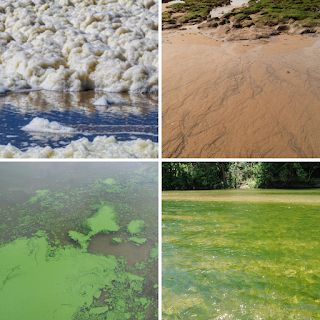
  • Has foam, scum, algal mats, or paint-like streaks on the surface.
  • Has dead fish or other animals washed up   on the shore.

 See figure 1 for examples of blooms. Before you visit a local swimming area, find out if it has a  current blooms, or a history of blooms by clicking here.

You should also NEVER drink, prepare food, cook, or make ice with untreated surface water – whether   it has an active bloom or not. Do not fill pools with water directly from lakes, rivers, or ponds.

Figure 2

Don’t forget about your fur babies.

If they are anything like mine (say hi to Cami in figure 2), getting them to leave the beach is the hardest part of the day. Dogs can be at an increased risk of poisoning by cyanobacteria because of their general behaviors – swimming, drinking the water, and eating dead animals (like fish) found near the shore. Contact your veterinarian immediately if your pet seems sick after going in or near water. Some signs and symptoms include: excessive salivation, vomiting, fatigue, staggered walking, difficulty breathing, and convulsions.

Pets or kids raced ahead and went in the water before you saw something sketchy? Don’t panic. Rinse them, and yourself, off immediately with tap water from a sink, shower, hose, or outdoor spigot. Don’t let your pets lick their fur until they have been thoroughly rinsed.

If you come across a suspected bloom, it is important that you report it. For us that means visiting the DEC page here. Be sure to take a photo of the suspected bloom, you will attach it to your report.

Some blooms are short lived, dispersing in a few days. Others last longer. Best practice is to check the database before selecting which beach to visit. If you see something you don’t like, stay out and report it. Not sure what you are seeing? When in doubt, stay out!


Molly Flynn
Principal Public Health Educator
Division of Health Planning & Promotion

Tuesday, October 15, 2019

"Just" Baby Teeth?


“They’re just baby teeth and will eventually fall out. Why do we even have to worry about them?” I often get asked this question at check-ups and never feel like I can stress enough how important it is to take good care of those baby teeth.

Did you know that tooth decay in young children is THE most common chronic disease of early childhood? If left untreated tooth decay in children can lead to:
·         Pain,
·         Life threatening infections,
·         Difficulty chewing,
·         Malnutrition,
·         Trouble focusing in school,
·         Crooked adult teeth, and
·         Low self-esteem.
The good news is that most tooth decay and cavities are preventable!

What are cavities?

Cavities are holes in our teeth. They occur when three things mix together: bacteria, sugar (from the food that we eat) and teeth. If we don’t brush and floss regularly the bacteria and sugar build up and form a sticky substance called plaque. The bacteria gets nice and comfy in that plaque and turns the food that we eat into acid. Over time this acid wears down our teeth and a cavity (a hole!) grows.


Source: American Dental Association


Yikes! How can we prevent cavities?
Brush, floss, brush, floss, brush…you get the idea J Brushing your child’s teeth (and yours!) twice each day using a toothpaste with fluoride is the best way to prevent cavities.

When should I start brushing my child’s teeth?

As soon as the first baby tooth erupts! Fluoride is important for baby teeth because it makes the enamel stronger and more resistant to decay. For children younger than three years old you will want to start out using a smear of fluoridated toothpaste, no bigger than a grain of rice. This small amount has been shown to be safe for children. Once your child can spit the toothpaste out, usually around age three, you can start using a pea-sized amount.

Source: American Dental Association

My child grazes on snacks all day, how can I keep his chompers clean?

Offer your child meals and snacks that are low in sugar (carbohydrates). The bacteria in our mouths love sugar and turn it into acid that eats holes in our teeth. The more time sugar is on your child’s teeth, the more likely they are to get a cavity. This is good to know because HOW children eat can be just as important to their teeth as WHAT they eat. Children who graze on snacks throughout the day, or fall asleep with a cup of juice or milk at night, have their teeth swimming in sugars all the time. Here are some tips to curb the carbs: 

·         Opt for protein rich snacks like cheese, nuts and fresh vegetables.
·         Don’t offer snacks after brushing at night.
·         If your child is thirsty in between meals or during the night give them plain water.

What else can I do to protect my child’s pearly whites?


Visit a pediatric dentist! It is recommended to see a pediatric dentist within six months of the first tooth coming in, and no later than age one. Just as you would take your child to well child check-ups, it is important to take him or her to the dentist before a problem develops. This will create positive experiences at the dentist and a foundation of good oral health. Remember, they are not “just baby teeth” they are the building blocks for a lifetime of healthy teeth.

Dr. Christopher Goodell
Lakeshore Pediatric Dentistry  

Thursday, March 22, 2018

Lead and Nutrition: What's the Connection?


All children need to be tested for lead at one year old and two years old.  Along with pediatricians, the Clinton County Health Department helps identify children who have lead poisoning.  When children have high lead levels I can teach families how to keep their homes clean of lead dust and what to eat to help decrease lead in the body. I can help you in person at your home or offer you information that can be mailed to you. Since it is National Nutrition Month, I have some information below that is helpful to keep you and your children healthy!

Did You Know

Eating a healthy diet could help prevent childhood lead poisoning?  A diet rich in calcium, iron, and Vitamin C, can help reduce the absorption of lead into the body.  Lead poisoning can cause learning, growth and behavioral problems in young children. Click here to find out the dietary recommendations for your child. 

This is How It Works

Lead dust is either inhaled, when it’s kicked-up into the air, or ingested, when objects contaminated with lead are put into the mouth.  Once lead gets into the blood stream it tricks the body into thinking it is calcium and gets absorbed into the bones, brain and nervous system. Lead is also absorbed into the body faster on an empty stomach or if the diet is high in fat.

Here’s What You Can Do

·         Identify and remove all sources of lead exposure.

·         Wash hands with soap and water for 20 seconds before eating and before naps and bedtime.

·         Wash all fruits and vegetables before cooking or eating.

·          Eat four to six small meals or snacks throughout the day to keep your stomach full and reduce the body’s absorption of lead.

o    Foods high in calcium:  milk or milk products, green leafy vegetables, salmon, calcium-fortified foods like tofu, orange juice and soy milk.

o   Iron rich foods: lean red meat, eggs, fortified cereals, bread, pasta, dried fruit, beans and lentils.

o   Don’t forget your Vitamin C!  It is commonly found in citrus fruits such as cantaloupe, strawberries, mangos, and melons as well as in peppers, tomatoes and potatoes.

For more information call the Clinton County Health Department at 518-565-4848 and ask to speak to a Lead Poison Prevention Program Nurse or visit http://www.clintonhealth.org/leadpoisoning.

Noreen Wolansky, RN

Registered Professional Nurse

HABs – Say Algae You Later!

Being a Clinton County native, summer notifications of harmful algal blooms (HABs) at local beaches are nothing new. Certain places in our ...