Showing posts with label summer. Show all posts

Thursday, July 21, 2022

HABs – Say Algae You Later!

Being a Clinton County native, summer notifications of harmful algal blooms (HABs) at local beaches are nothing new. Certain places in our County provide the perfect recipe for HABs – lots of sunlight; shallow, calm water; and warm temperatures. It is important to pay attention to these alerts or notifications to keep everyone safe and healthy. They can help decide which beaches to choose for a fun day on the water with your favorite humans and dogs.

What are they?

HABs are the rapid growth of cyanobacteria (sometimes referred to as blue-green algae). These blooms create toxins that can be harmful to people and animals. Coming in contact with, drinking (or swallowing), or even inhaling these toxins can make you very sick. Symptoms vary based on which cyanotoxin (a list I cannot pronounce) but can include: stomach pain, headache, muscle weakness, dizziness, vomiting, and diarrhea. If you think you might have symptoms caused by HABs, contact your healthcare provider and let them know you suspect it may be related to cyanobacteria.


Decided you don’t feel like wasting your summer days at home sick with any of the gross symptoms listed above? Me either! Here is what to look for before going in the water.

Figure 1

Don’t go in water that:

  • Smells bad.
  • Looks discolored.
  • Has foam, scum, algal mats, or paint-like streaks on the surface.
  • Has dead fish or other animals washed up   on the shore.

 See figure 1 for examples of blooms. Before you visit a local swimming area, find out if it has a  current blooms, or a history of blooms by clicking here.

You should also NEVER drink, prepare food, cook, or make ice with untreated surface water – whether   it has an active bloom or not. Do not fill pools with water directly from lakes, rivers, or ponds.

Figure 2

Don’t forget about your fur babies.

If they are anything like mine (say hi to Cami in figure 2), getting them to leave the beach is the hardest part of the day. Dogs can be at an increased risk of poisoning by cyanobacteria because of their general behaviors – swimming, drinking the water, and eating dead animals (like fish) found near the shore. Contact your veterinarian immediately if your pet seems sick after going in or near water. Some signs and symptoms include: excessive salivation, vomiting, fatigue, staggered walking, difficulty breathing, and convulsions.

Pets or kids raced ahead and went in the water before you saw something sketchy? Don’t panic. Rinse them, and yourself, off immediately with tap water from a sink, shower, hose, or outdoor spigot. Don’t let your pets lick their fur until they have been thoroughly rinsed.

If you come across a suspected bloom, it is important that you report it. For us that means visiting the DEC page here. Be sure to take a photo of the suspected bloom, you will attach it to your report.

Some blooms are short lived, dispersing in a few days. Others last longer. Best practice is to check the database before selecting which beach to visit. If you see something you don’t like, stay out and report it. Not sure what you are seeing? When in doubt, stay out!


Molly Flynn
Principal Public Health Educator
Division of Health Planning & Promotion

Tuesday, June 14, 2022

Backyard Pests – They’re Starting to Tick Me Off!

With summer looking like it is here to stay I am ready to enjoy the fresh air and sunshine. But it seems like every time I try, I find myself swarmed by mosquitoes or picking ticks out of my dog’s fur. I’M BUGGING OUT! Luckily there are some fool-proof tips and tricks to help reduce your chances of getting bitten by both, and to save a little bit of sanity.

Let’s start with ticks. These creepy, crawly pin-heads (no, seriously they are the size of a pin head) spread diseases that make you sick. In our area, our biggest concern is Lyme disease, but we also see a few cases of Anaplasmosis and Rocky Mountain Spotted Fever each year. Cases of Lyme disease have increased 200% in Clinton County over the past 3 years. Grossed out? Me too. But we can take a few easy steps to avoid run-ins or bites from these guys.


1. 
Avoid areas they like. This includes grassy, bushy, brushy areas with tall grass and leaf litter.

2. Prepare for an encounter. You don’t need to be deep in the woods to get a tick bite; the run-in could happen in your own backyard. Before you head outdoors:

  • Apply an EPA-registered insect repellent.
  • Cover your skin as much as possible (enclosed shoes, long pants and shirts, tall socks).
  • Wear light colors. This makes spotting a tick easier.
  • Treat clothing with permethrin.

3. Remove any ticks before they have a chance to bite.

  • Do a tick check on your whole body using a mirror to see the tricky areas. See figure 1 to learn where to look on people and pets.
  • Take a shower as soon as you can. This will wash away any unattached ticks.
  •  Put the clothes you wore in the dryer for at least 10 minutes on high to kill any ticks.

Figure 1
Did all these things and still found a tick? I’ve been there! Don’t panic. Not all ticks are infected and your risk of Lyme disease decreases if you remove it within 24-36 hours. Click here to watch a video on the best way to remove ticks.

If you do find one of these pesky little dudes latched on, keep an eye on the bite site for a few weeks. If you develop a fever, chills, headache, rash, muscle or joint pain, or swollen glands within 30 days of your bite, contact your doctor. Be sure to let them know about your tick bite.


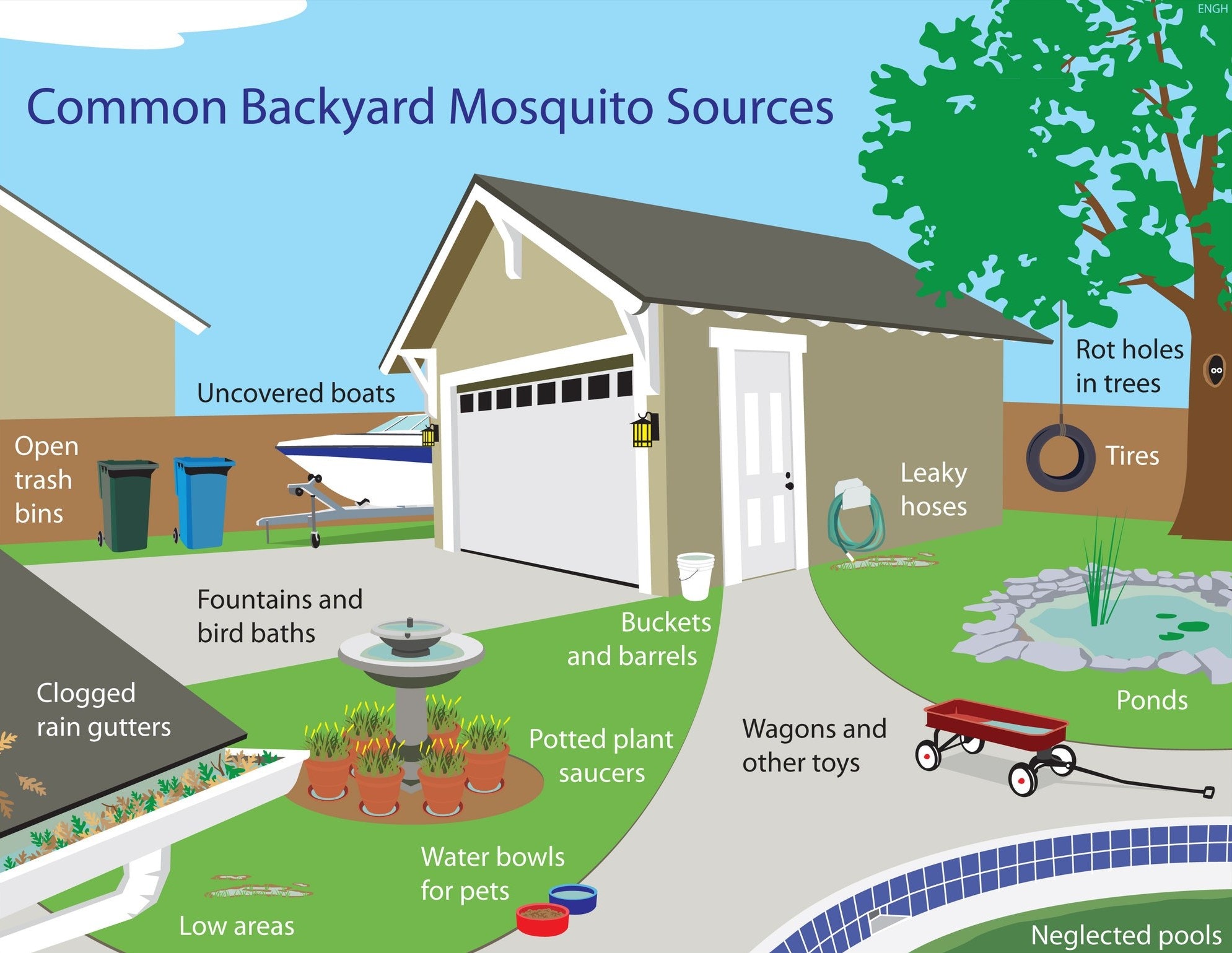
On to the most annoying creatures on the planet – mosquitoes! While they can carry diseases like West Nile Virus and Eastern Equine Encephalitis, in Clinton County they tend to be more of a nuisance than a disease spreader. If you seem to have an overabundance in your backyard, chances are you are to blame. How so? Mosquitoes lay their eggs in or near water. Then their babies grow-up in that water before flying away and biting. This entire process only takes about a week! So step one in reducing mosquitoes around your home is eliminating standing water at least weekly.

  • Figure 2
    Empty and scrub, turn over, cover, or throw away items holding water. Some examples include: tires, buckets, planters, toys, pools, birdbaths, flowerpots, and trash containers (see figure 2).
  • Make sure your gutters are draining properly.
  • Tightly cover any water storage containers – like buckets, cisterns and rain barrels. If it doesn’t have a lid, cover is with wire mesh.
  • Repair gaps or cracks in your septic tank. Cover open vent or plumbing pipes.
  • Drill holes in the bottom of recycling containers if you keep them outdoors.

·    When used as directed, insect repellents are the BEST protection.

  •       Always follow the product label instructions
  •       Reapply as directed.
  •      Do not spray on the skin under clothing.
  •      If using sunscreen AND insect repellent, apply sunscreen first, then the insect repellent.
  •      Store out of reach of children.
  •      Do not allow children to apply it themselves.
  •      Do not use it on children younger than 2 months.
  •      When applying to children, apply it to your hands first. Then rub it onto the child’s skin.

Don’t forget to keep the mosquitoes outside. Repair screens and keep doors closed.

Don’t let ticks and mosquitoes ruin your summer. Prepare for them, take steps to avoid them, and be ready to treat bites in case one or two get through. For more tips on having a safe and healthy summer, check out our Summer Safety Guide. Missed our Spring Safety Guide? No problem!

Molly Flynn

Principal Public Health Educator

Division of Health Planning & Promotion

Friday, June 4, 2021

Lyme Disease Cases Have Tripled in Clinton County…Here are 5 Ways to Prevent Tick Bites

As I am writing this, I have three children who are 8 years, 5 years, and almost 9 months old. Two things I always tell my children; I love you, and my job as your mom is to keep you safe! They tend to roll their eyes at the safety part (well the 8 year old and 5 year old do anywayJ). There are so many things to worry about as a parent but one thing I am extra cautious about are ticks. This is especially true from April-September (although don’t get too relaxed in late fall or winter, I found a tick crawling on my infant in mid-November).  

Ticks can carry a wide range of diseases. That is why I take extra care when it comes to not only
protecting my family but also my pets from these pesky creatures. Lyme disease (carried by the deer or black-legged tick) is the most common illness transmitted by ticks. Cases of Lyme disease have more than tripled in Clinton County since 2018, so it is more important than ever to be on the lookout for ticks.

5 Ways to Prevent Tick Bites:

1.  Know where ticks may be lurking

a. Ticks like grassy, bushy, or wooded areas but they also like to live on our pets.

b.   Always walk in the center of trails and avoid wooded and brushy areas with tall grass and leaf litter.

c.    You don’t need to be deep in the woods to get a tick bite, it can happen in our own backyards.

2. Apply insect repellent. This really deserves its own blog post, but here are a few quick tips to know before applying insect repellent on kids:

a.       Never apply insect repellent on infants younger than 2 months of age.

b.       Use Environmental Protection Agency (EPA) registered insect repellents containing, DEET, picaridin, IR3535, Oil of Lemon Eucalyptus (OLE), para-menthane-diolon (PMD), or 2-undecanone

                                                               i.      The American Academy of Pediatrics (AAP) recommends repellents should contain no more than 30% DEET when used on children (a higher concentration does not mean more protection).

                                                             ii.      Do not use products containing OLE or PMD on children under 3 years old.

                                                           iii.      Do not use products that combine DEET and sunscreen, although these seem like a great idea, it can actually reduce the effectiveness of the sunscreen and accidentally expose your kiddo to more DEET, because the sunscreen needs to be applied more often.

3. Dress for Success

a.       Treat clothing and gear with products containing 0.5% Permetherin.  It is important to note that this should only be applied to clothing, not to skin.

b.       Dress in light colors (it makes it easier to spot ticks), long pants, a lightweight long sleeved shirt, socks, and closed shoes before heading outdoors. Put hair in a ponytail and wear a broad brimmed hat.

4. After you come inside

a.       Check clothing, gear, and pets for ticks.

b.       Throw clothes in the dryer and tumble dry them on high heat for 10 minutes.

c.        Bathe within two hours after coming indoors.

5. Daily Tick Checks:

a.       Ticks are tiny and like to hide! Regardless if you or your kids have been outside or not, check everyone’s entire body for ticks daily, paying close attention to specific areas; under the arms, in and around the ears, inside belly button, back of the knees, in and around the hair, between the legs, and around the waist.

Ugh, I found a tick, now what?!

·         First, don’t panic! The key is to remove the tick as soon as possible. Remember - not all ticks are infected and your risk of infection is greatly reduced if the tick is removed within the first 24-36 hours,

·         Use fine tipped tweezers to grab the tick as close to the skin as possible,

·         Pull upward with steady, even pressure (don’t twist or jerk the tick),

·         After removing the tick, wash the bite area and your hands with rubbing alcohol or soap and water,

·         Check for symptoms. If any develop contact your or your child’s healthcare provider right away.


For more info on ticks or how to stay safe this summer, read our Summer Safety Guide!


Lindsay Dareff

Registered Professional Nurse

Division of Health Planning and Promotion

Thursday, July 18, 2019

Paddle with Me

In my previous life I spent many days on the Saranac River as a paddling instructor. Paddling can be a fun and exciting life-long sport - if you practice it correctly! With some help from my friends at the Town of Plattsburgh Parks & Recreation Department, I have some quick tips to make your next paddle one to remember.

Wear a Life Jacket
Life jackets, or PDFs (personal floatation devices), are the most critical piece of safety equipment to have no matter what kind of vessel you plan to paddle. Make sure your PDF is: 

It should be tight enough that you cannot lift it by the shoulder-straps. Remember, a PDF can only do its job if you are wearing it and it is fastened correctly.

Check the Weather Forecast
ALWAYS check the weather reports for the area you plan to paddle in before you head out on your water adventure. The last thing you want to do is get caught half-way between point A and point B when a thunderstorm hits (not that I’m speaking from experience, but hypothetically your arms would be burning, you would be soaking wet and you would be cursing…a lot). No matter the weather, you should never go out alone and always tell someone where you are going and when you expect to be back.

Dress Appropriately and Be Prepared
Wear:
  • First and foremost – SUNSCREEN and a hat (whether it’s sunny or overcast).
  • Clothing that is lightweight and quick drying. Consider packing a windbreaker.
  • Shoes that are waterproof AND will stay on your feet. There is a yellow croc on the bottom of the Saranac River who will forever be missing his partner in crime.

Bring:
  • A whistle or signaling device in case of an emergency.
  • A dry-bag to keep your belongings safe.
  • Water and snacks to keep you hydrated and happy J.

Stability
Typically, width = stability. Canoes tend to be a standard size, but you can reduce the risk of swamping your canoe by loading it carefully. A recreational kayak is wider and more stable than a sea kayak and a wider paddleboard can also help with stability. No matter the vessel, be sure it is ALL THE WAY in the water before you try to get in or on – half in and half out is the worst spot to be for balance. I have seen more people tip getting in or out than in the middle of the water.

Paddling Basics
Kayaks
  • Stand in the water with one foot on each side of the cockpit and slowly sit down in the driver’s seat.
  • To paddle go in at your toes and out at your waist. Alternate your strokes, one per side.
  • Rotate your core with each stroke – if your arms are getting tired you probably aren’t engaging your core enough!

Paddle Boards
  • Plant your hands and knees on the board just behind the board’s halfway point.
  • Once stable slowly stand with your feet hip distance apart and your knees slightly bent.
  • Reach your paddle forward and pull the water back; you will remove the paddle from the water just behind your feet. Take a few strokes then switch sides.

Canoes
  • Bring a buddy and board your vessel, one at a time. The paddler in the back will want to enter in the middle of the boat. After the paddler in the front is in their seat, slowly scoot back into yours.
  • The rider in the front is the workhorse – they paddle continuously. The rider in the back keeps track of where the boat is going.
  • Take a few strokes on one side then switch. Get into a rhythm with your co-pilot.

Know your paddling limits and remember, however far you paddle out you will also have to paddle back. Whether it is on a paddleboard, in a kayak or canoe, a summer paddling adventure is great experience for the whole family. Be sure to follow all of our safety tips and enjoy yourself! It is summer after all!


Molly Flynn, Senior Public Health Educator
Division of Health Planning & Promotion

Thursday, June 28, 2018

Hot Dog! (Beating the Heat this Summer)

After what seemed to be an endless, frigid winter it now seems silly to complain about being too hot. But here we are, just barely into the official dog days of summer and I am already sick of being a stuffy, sweaty, hot mess with hair that has a mind of its own! As hot days become more frequent stay cool, stay hydrated and stay informed!

Safety First

Heat safety is important no matter who you are, but the following groups should be extra cautious when the temperature rises: older adults (65+), infants & children, those with chronic conditions, those in low income areas, athletes, those who work outdoors, and our pets! Learn the signs and symptoms of heat-related illness and check your local news for extreme heat alerts.

  • Drink plenty of fluids before you are thirsty, no matter how active you are. As you sweat you will need to replenish the fluids your body has lost.
  • Avoid alcoholic beverages or those high in sugar as they will cause you to lose more body fluid.
  • Don’t forget about your pets! Make sure they have plenty of water, and leave it in a shady area to encourage them to take a break from the sun.

Beat the Heat

  • Stay in air-conditioned areas as much as possible. Going stir crazy? Check out what’s happening at your public library or do some window shopping at the mall.
  • Avoid hot and heavy meals. They add unnecessary heat to our bodies - not to mention the heat ovens and stoves give off!
  • Limit outdoor activities to the times of the day that are typically cooler (i.e. early morning or evening).
  • Apply sunscreen with SPF 15 or higher before heading outside. Sunburns affect the body’s ability to cool itself down. “Broad Spectrum” sunscreens or those marked “UVA/UVB” work best.
  • Choose lightweight, light-colored and loose-fitting clothing.


#CheckForBaby

NEVER leave infants, children or pets inside a parked car! Even with the windows cracked a car will quickly heat up to dangerous temperatures. Remember to #checkforbaby!

  • Leave one of your shoes in the back seat with baby. When you get out of the car you won’t get far before you realize you are missing a shoe!

  • Leave a stuffed animal in the car seat. When you put baby in move it to the front seat where it is visible.

  • Leave an item you won’t forget, such as your purse, wallet or cell phone in the back seat.


Wishing you and your family (both the two and four legged variety) a fun, memorable and safe summer!

Molly Flynn, Senior Public Health Educator
Division of Health Planning and Promotion

HABs – Say Algae You Later!

Being a Clinton County native, summer notifications of harmful algal blooms (HABs) at local beaches are nothing new. Certain places in our ...