Showing posts with label clinton county. Show all posts

Thursday, July 21, 2022

HABs – Say Algae You Later!

Being a Clinton County native, summer notifications of harmful algal blooms (HABs) at local beaches are nothing new. Certain places in our County provide the perfect recipe for HABs – lots of sunlight; shallow, calm water; and warm temperatures. It is important to pay attention to these alerts or notifications to keep everyone safe and healthy. They can help decide which beaches to choose for a fun day on the water with your favorite humans and dogs.

What are they?

HABs are the rapid growth of cyanobacteria (sometimes referred to as blue-green algae). These blooms create toxins that can be harmful to people and animals. Coming in contact with, drinking (or swallowing), or even inhaling these toxins can make you very sick. Symptoms vary based on which cyanotoxin (a list I cannot pronounce) but can include: stomach pain, headache, muscle weakness, dizziness, vomiting, and diarrhea. If you think you might have symptoms caused by HABs, contact your healthcare provider and let them know you suspect it may be related to cyanobacteria.


Decided you don’t feel like wasting your summer days at home sick with any of the gross symptoms listed above? Me either! Here is what to look for before going in the water.

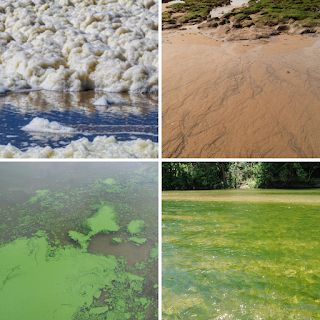
Figure 1

Don’t go in water that:

  • Smells bad.
  • Looks discolored.
  • Has foam, scum, algal mats, or paint-like streaks on the surface.
  • Has dead fish or other animals washed up   on the shore.

 See figure 1 for examples of blooms. Before you visit a local swimming area, find out if it has a  current blooms, or a history of blooms by clicking here.

You should also NEVER drink, prepare food, cook, or make ice with untreated surface water – whether   it has an active bloom or not. Do not fill pools with water directly from lakes, rivers, or ponds.

Figure 2

Don’t forget about your fur babies.

If they are anything like mine (say hi to Cami in figure 2), getting them to leave the beach is the hardest part of the day. Dogs can be at an increased risk of poisoning by cyanobacteria because of their general behaviors – swimming, drinking the water, and eating dead animals (like fish) found near the shore. Contact your veterinarian immediately if your pet seems sick after going in or near water. Some signs and symptoms include: excessive salivation, vomiting, fatigue, staggered walking, difficulty breathing, and convulsions.

Pets or kids raced ahead and went in the water before you saw something sketchy? Don’t panic. Rinse them, and yourself, off immediately with tap water from a sink, shower, hose, or outdoor spigot. Don’t let your pets lick their fur until they have been thoroughly rinsed.

If you come across a suspected bloom, it is important that you report it. For us that means visiting the DEC page here. Be sure to take a photo of the suspected bloom, you will attach it to your report.

Some blooms are short lived, dispersing in a few days. Others last longer. Best practice is to check the database before selecting which beach to visit. If you see something you don’t like, stay out and report it. Not sure what you are seeing? When in doubt, stay out!


Molly Flynn
Principal Public Health Educator
Division of Health Planning & Promotion

Wednesday, April 13, 2022

Announcing the Clinton County Food Action Plan!

Key Points

  • Clinton County now has a Food Action Plan that can help align food system stakeholders around a common set of principles and goals.
  • Community members are encouraged to read the new action plan and get involved with efforts to make the local food system healthier, accessible, affordable, and sustainable.

It All Starts with a Plan

How can our community come together to ensure that everyone can access the fresh, delicious, nutritious food they need to thrive and stay healthy?

How can food system stakeholders — from farmers and gardeners that grow the food, to business and institutions that deliver the food — work together to promote sustainability and reduce waste?

And how can our community make food purchasing choices that support and expand the local food economy?

We now have a clear set of answers to questions like these!

The Clinton County Health Department (CCHD) is excited to announce the launch of the Clinton County Food Action Plan (CCFAP).

Developed in partnership with ChangeLab Solutions, a national nonprofit that uses the tools of law and policy to advance health equity, this food action plan establishes goals and priorities for food system partners and stakeholders.

Specifically, it creates a roadmap around which local government agencies, hospitals, community-based organizations, businesses, resident groups, and other food system stakeholders can coordinate their work.

Putting the Plan into Action

The food action plan focuses on four primary goals:

1. Enhancing collaboration and cohesion among existing food system stakeholders,

2. Supporting the local food and agricultural economy,

3. Reducing the amount of food waste sent to landfills and increasing the recovery of unused, edible food for community use, and

4. Increasing access to healthy and affordable foods

The plan outlines actions and strategies that local food system stakeholders can take to collectively strengthen and enhance our food system and sustain improvements in the long term.

Based on extensive research about the existing food system practices, partners, and policies in Clinton County, the plan identifies starting steps and strategies that stakeholders can take to implement suggested actions and strategies.

The plan also recommends potential measurements that stakeholders can use to track and evaluate their progress in following the action plan’s suggestions.

Lastly, the Clinton County plan offers examples from other communities throughout the United States that have pursued similar approaches to revamping their local food system.

Planning for a Healthier Clinton County

With so many different business, public institutions, and community organizations that intersect with the Clinton County food system, there is no one size fits all solution to improving the local food system.

While comprehensive and extensively researched, it is important to note that this plan is a living document. It is intended to be reviewed and revised to adapt to changing environments and community conditions.

The action plan serves as a starting point — to galvanize and unite food system actors around a common set of goals and priorities. The plan will be a driving document to guide and sustain partnership and initiatives into the future.

Our hope is that by coordinating food system stakeholders, and evaluating the food system from beginning to end, we will be able to decrease the prevalence of food insecurity and diet-based diseases, like obesity and diabetes, within the Clinton County community.

We are genuinely excited to see how this plan leads to profound, positive change in Clinton County in the years ahead.

Take Action

  • Read the full length Clinton County Food Action Plan (CCFAP) here.
  • Contact us for additional information.


Patrick Glass

Digital Content Developer

ChangeLab Solutions

Monday, October 4, 2021

Everything You Need to Know About WIC

I started working at Clinton County WIC in February of this year and every day I am so thankful to have a job that has such a huge impact on those in need. Women, Infants and Children, more commonly known as WIC, is a public health nutrition program that is funded through the United States Department of Agriculture (USDA). The purpose of WIC is to provide education and proper nutrition to mothers of babies up to 6 months old, mothers of breastfeeding babies up to 12 months old and infants/children up to age 5. The wonderful people of WIC work to help families develop healthier habits so that they can live longer, happier lives!

How do I enroll? Call your local WIC agency or go online to find one closest to you! To qualify for WIC in New York State you must:

  • Live in NYS
  • Meet income limits OR get benefits from Medicaid, SNAP, or TANF
  • Have a dietary need

What’s New in WIC? 

  • No more checks! WIC benefits are now on EBT cards.
  • WIC2GO mobile app helps you track benefits, check upcoming appointments, and scan WIC approved items in the store.

What Does WIC Provide?

Our goal is to provide families with the resources and education to live happier and healthier lives. We work hard to support the families we see in every way we can. Call us today to see if you or your loved ones qualify 518-565-4830.


Emily Hutchins, RD, CDN, CLC

WIC Public Health Nutritionist

Division of Health Planning and Promotion 


Sunday, August 29, 2021

Don’t “Wing It”: Follow These Simple Tips to Catch the Bat


Don’t freak out, don’t freak out, don’t freak out
! That is what I kept telling myself when I woke up to a bat in my house just last month! My first instinct was to open the door and swat it outside – good riddance! But then I remembered my training as a Public Health Sanitarian at the Clinton County Health Department. Since I was sleeping and didn’t see the bat enter my house I knew I needed to capture it so it could be tested for rabies. Rabies is a fatal viral infection that can be spread to people and pets if they are bitten by an infected animal, such as a bat.

Bats have small, sharp teeth which may not leave a visible bite mark and a bite from a bat during the night may not awaken a sleeping person (creepy, I know). Bats should be captured and tested if they are found in a room where a person is sleeping, with an unattended child, someone who is under the influence of drugs or alcohol or someone with a mental disability. So my next step was to capture this thing…but how?! I pulled up this video for a quick refresher and outlined the steps for you:

  • Close doors, windows and closet doors to keep the bat in the room.
  • Turn on the lights if the room is dark.
  • Wear gloves (heavy, preferably pliable thick leather) and wait for the bat to land. It is important to not damage the bat’s head.
  • Cover the bat with a coffee can or similar container with a lid.
  • Slide a piece of cardboard under the can, trapping the bat.
  • While firmly holding the cardboard in place against the top of the can, turn the can right side up.
  • Replace the cardboard with the lid (if no lid, tape the cardboard tightly to the can).
  • If you live in Clinton County, call the Clinton County Health Department at 518-565-4870. If you live in a different county, call your local health department.


If I would have seen the bat enter my house I could have opened the windows or door so the bat could have escaped. But there I was, with a bat in a cool whip container. Lucky me.

You may be asking yourself, “What if I couldn’t catch the bat and it got away?”

If we (Clinton County Health Department) are unable to test the bat for rabies and there is a chance you (or your family) were exposed we are going to recommend postexposure prophylaxis (PEP).

Most bats leave in the fall or winter to hibernate, so guess what I will be doing? Bat-proofing my home! Here are some things I will be looking for/doing:

  • Look for holes that might allow bats to enter and seal any openings larger than a quarter-inch by a half-inch.
  • Use window screens, chimney caps, and draft-guards beneath doors to attics.
  • Ensure that all doors to the outside close tightly.

In addition to my fall bat-proofing, I just checked my two pup’s vaccinations to make sure they are up-to-date (phew!). If your furry friends need their rabies vaccinations check out our FREE rabies clinic schedule.

Remember, you cannot tell if a bat has rabies by looking at it or by the way it acts. The only way to know if an animal has rabies is to send it for testing. Curious about the rabies program at the CCHD? Check out this blog.

Karissa LaBonte

Public Health Sanitarian

Division of Environmental Health and Safety

Monday, August 16, 2021

The ‘Art’ of Placemaking

“Working Together for a Healthier Community” is our motto here at the Clinton County Health Department (CCHD). I, for one, am excited that we are able to bring this motto to life by facilitating the creation of unique and healthy spaces throughout our community, with help from residents like you!

We recently partnered with 18 locally-owned businesses and community-based organizations in Clinton County through a grant called Operation: Light, Quick, Cheap (LQC) provided by the New York State Health Foundation (NYSHF). Partners were awarded funding to create safe, fun and eye-catching spaces that promote healthy behaviors.

This was such a fun grant to be a part of and I am so excited to share the ‘out of the box’ projects that were completed. They all involve placemaking which allows businesses to make cost effective improvements to their spaces to promote physical activity and/or healthy eating.  

If you have time this summer I would encourage you to explore some of Clinton County’s newest attractions:


  1. Beekmantown Volunteer Fire Department - 6973 NY-22, West Chazy, NY 12992

Project Name: BVFD Memorial & Community Space

Project Description: An ADA sidewalk was installed for all community members to have convenient access from the parking lot to the pavilion area. Benches and lighting for the area were donated.


  1. Black Brook General Store - 781 Silver Lake Rd, Au Sable Forks, NY 12912

Project Name: Bike & Visitor Friendly Space

Project Description: A bike repair station and bike racks were added to the store’s location to increase active transportation. Additionally, two oversized Adirondack chairs now sit at the store for photo opportunities and to increase visitors.


  1. The Cat’s Meow Thrift Shoppe -90 Bridge St, Plattsburgh, NY 12901,  Accepted by Outside Art: Plattsburgh Public Art Project

Project Name: “Community Garden” Mural

Project Description: Coordinated by Outside Art: Plattsburgh Public Art Project, the Community Garden Mural features colorful flowers with an interactive “find the cats” element. This mural was completed with help from local community members, art students from Plattsburgh State, and individuals from the Autism Alliance of Northeastern New York. There are 20 cats, 15 snails, 9 mushrooms, and 5 bugs in the mural; can you find them all?


  1. Central Nutrition Smoothie & Juice Bar - 11149 Route 9 Champlain, NY 12010

Project Name: Gathering Space

Project Description: A beautiful space with landscaping for the community to gather and just chat while playing a game of chess or checkers. Have a bike? Take a ride to this new location, there are new bike racks conveniently located next to this community area.


  1. City of Plattsburgh Fire Department - 7 South Platt St, Plattsburgh NY 12901

Project Name: The “Splash!” Mural 

Project Description: This mural brings the community together and supports local essential workers. Outside Art: Plattsburgh Public Art Project collaborated with the local fire department, NYSATA art teachers, and local students to bring some life into a plain firehouse wall. The theme of water encompasses the firehouse’s proximity to the Saranac River, the lifesaving resource that firefighters use every day, and the feeling of joy people get from engaging in recreational activities in or near water. 


  1. City Well - 30 City Hall Place, Plattsburgh, NY

Project Name: Community Well-ness Project

Project Description: This design features interactive sidewalk and concrete barrier art with an under the sea, fish theme that surrounds a community seating area. Want to play in the art? Head inside for some chalk!


  1. Clinton County Child Advocacy Center – 130 Arizona Ave, Plattsburgh NY 12903

Project Name: Welcoming, Friendly Fencing

Project Description: A colorful, playful space was created for visitors to feel welcomed and comfortable with a whimsical flower pattern bordering the fenced in gathering area.


  1. Clinton County Historical Association – Peace Park

Project Name: Tsi ietsenhtha (Jee Yeh Jen Ta)/Plattsburgh Art Project

Project Description: A turtle art sculpture was placed in Peace Park. The shell of the turtle has a different design on each, representing the history of the Native people.


  1. Clinton County Mental Health & Addiction Services - 130 Arizona Ave. Plattsburgh, NY 12903

Project Title: We are Here!

Project Description: Sidewalk art and benches with encouraging words from the parking lot to the entryway creates a welcoming space for community members.


  1. Cornerstone Pharmacy – 72 Champlain St, Rouses Point NY 12979

Project Title: Farmacy 2.0

Project Description: The Farmacy Project is an effort to provide locally grown and produced food to area residents. Items include: fruits, vegetables, meats, cheeses, eggs, and bulk food bins items. This allows the community to have access to a Farmers Market, that is usually a once a week event, everyday! SNAP/EBT accepted.


  1. Cumberland Bay Market - 1544 Cumberland Head Road, Plattsburgh, New York 12901

Project Title: From Rays & Seeds to Rows & Harvest

Project Description: Raised garden beds were installed to grow fresh produce to use in the meals cooked by the market. A children’s tour of the garden was offered with a Master Gardener that taught children about the gardening process. The market also has their fresh produce for sale and encourages community members that are food insecure to help themselves to some produce.


  1. D & D Meats – 8945 Rt 22, West Chazy NY 12992

Project Title: Corner Oasis

Project Description: Farm cutouts for photo opportunities, bike racks to encourage active transportation, and fresh produce are all located in this Corner Oasis.


  1. Lakeside Coffee – 109 Lake St, Rouses Point NY 12979

Project Title: Project Sunburst

Project Description: This outside community park is newly constructed with benches, games tables, bike racks, and beautiful landscaping. If you’re feeling hungry or thirsty, head across the street to Lakeside Coffee for a bite to eat! Looking for other activities that are available in Rouses Point? Visit the message board in the park that maps out local businesses, community areas and events.


  1. M’Akin Things Homemade - 1166 Cook St, Dannemora, NY 12929

Project Title: Welcoming Outdoor Space

Project Description: M’Akin Things Homemade just made the community more visually pleasing for customers, visitors, and residents. Check out the artistic balloon dog benches, sustainable greenery and homemade garden beds that double as safety railing on the corner of Cook and Emmons Street. 


  1. Maui North – City of Plattsburgh

Project Title: Artistic Bike Racks Project

Project Description: Art and bike racks do mix! Maui North partnered with the City of Plattsburgh to install fun shaped bike racks throughout the City. Can you find all 11 locations? Hint: There’s a book shaped bike rack at the Plattsburgh Public Library.


  1. Rouses Point Library - Rouses Point Civic Center, 39 Lake St, Rouses Point NY 12979

Project Title: Hop, Skip, Read!

Project Description: StoryWalk® is an innovative way for children and families to enjoy reading and the outdoors at the same time and it is now in Rouses Point. Visit the StoryWalk® to read and enjoy the interactive walkway with painted stencil activities.


  1. Strand Center for the Arts - 23 Brinkerhoff St, Plattsburgh, NY 12901

Project Title: Melody Park

Project Description: An outdoor musical art park is here for you to enjoy the sound of music in an open air space. Check out the new addition during an artisan market, outdoor concert, or just when you’re out on your next stroll.


  1. West Chazy Recreation Park

Project Title: Merry-Go-Cycle (coming in September!)

Project Description: Bring the kids to enjoy a newly installed merry-go-cycle while you enjoy playing tennis or pickle ball on the courts that were recently resurfaced in 2020.


Amanda Prenoveau

Public Health Educator

Division of Health Planning and Promotion

Sunday, August 8, 2021

How to Help Your School-Aged Kiddos Make Better Food Choices

One of the most common questions I get as a Registered Dietitian is “So...what exactly should I be feeding my kids?” The answer can be simple: “What exactly do you feed yourself?” Adults should strive to eat a well-balanced diet as much as possible. The eating habits parents have are often the same habits their children develop. The best way to feed your children is to set a good example for them and to join them in making wholesome food choices! Here are some tips on the main food groups kids should be eating. 

What Are The 5 Food Groups? 
Fruits 
Grains 
Protein 
Dairy 

 How Do I Help My Kids Make Good Food Choices? 
  • Aim for the Rainbow 
    • Including every food group and a wide variety of colors is a good way to make sure your kiddos are getting the vitamins and minerals that they need. 
    • Children who eat balanced meals are more likely to have better brain, muscle, and bone development and are less likely to grow up to be picky eaters.
  • Be a Role Model 
    • Bring your kids grocery shopping so they can help pick out fruits and veggies; caregivers are every child’s first teacher.
    • Prepare nutritious meals with your kids. A child that helps prepare a meal is more likely to want to eat it because they are proud of their hard work!
  • Avoid Saying Foods are "Good" or "Bad"
    • In the right amounts, all food can fit! 
    • Banning ‘junk’ food or saying only certain foods are ‘good’ can leave kids feeling fearful of food and could lead to disordered eating later in life. 
  • Have Options
    • It’s best to always have nutrient dense foods at home.
    • Kids like to feel independent; find time to let them choose between two nutritious snacks so they feel involved. 
What are Some Lunch/Snack Recipes My Kids Can Help Prepare? 


For more fun food ideas for you and your kids, find the WIC and Farmers Market recipes on the Clinton County Health Department website! 

Emily Hutchins, RD, CDN, CLC

WIC Public Health Nutritionist

Division of Health Planning and Promotion


Thursday, June 11, 2020

Food Waste Reduction, Who Has Time for That?

There are so many expectations in 2020 to be a functioning member of society. Eat local organic foods, use natural products, save the turtles, homeschool your kids, don’t get COVID-19, oh and raise kind humans who are also functioning members of society. I’m already exhausted and now I need to lower my carbon footprint by reducing our household food waste too? What does that even mean? I’m here to tell you, if I (wife, mom of 3, college student with a full-time job and homeschooling my children) can do it, so can you. Little things like changing shopping habits, reducing wasted food, and recycling food scraps don’t take that much extra time or effort but they can make a big impact at home, on the environment and your wallets.

Food waste doesn’t just happen at home, it happens all along the food chain, from the farm, to the store, to us, the consumer. By changing habits as a consumer, over time, we can make a much bigger impact on how our food system works. Keeping food scraps out of the landfill also helps reduce the impacts of climate change on another struggling mother, Earth.  

At my house we started simple by grocery shopping smarter. Making sure the refrigerator stays organized and having a good idea of what is on hand before a trip to the store is really helpful in not overbuying. Planning meals for the week is also beneficial to us and sticking to a list makes a huge difference in lowering our grocery bills each month. Getting creative with leftovers has always been a challenge for me, so to avoid throwing the leftovers in the trash, we stick to our planned meals, which are perfectly portioned for my family. We also created an “Eat Me First” section of the refrigerator so things don’t get pushed to the back and forgotten about (moldy).

Once we tackled shopping smarter, we could get to work staying organized. As soon as we get the groceries home any produce is immediately washed, cut and put away in clear storage containers so it is easily accessible and ready for meals or if the kids want a snack (seriously, when do they not want a snack?). We’re all more apt to grab something healthy like cut carrots or washed grapes if they are ready to eat. Preparing vegetables and fruits before they go into the fridge makes them last longer as well.  


Now for the fun part, composting! We took a few basic steps to eliminate wasted food, but let's be real, there is bound to be something that still goes uneaten. In researching what would work best for our family we decided we could benefit from turning the food scraps into compost and using it in our garden. You don’t always have to use the compost from your food scraps; solar digesters that break down the waste and allow it to seep into the soil are a good option or a neighbor with animals looking for food scraps could work too. We wanted this project to be as cost effective as possible so we opted for a homemade tumbler. Vegetable scraps, fruit peels, egg shells, coffee grounds and tea bags go right into our recycled canister on our kitchen counter. A lucky kid at my house wins the coveted award of taking it out to the tumbler when it’s full so not only are we helping the environment we are teaching responsibility too. Everyone wins.

If you’re still reading, I may have convinced you your family can do this too. Wanting to reduce food waste doesn’t have to be difficult and it definitely doesn’t have to cost anything. Whatever you’re doing at home now, keep up the good work, but know that we could all be doing a little more to reduce our food waste. Make small changes in your lifestyle over time. You will see a difference in the amount of trash you produce, and the amount of money you save. To answer the question, who has time for that?

The answer is, we all do!  

Thank you very “mulch”.

Carrie Healy

Program Assistant

Health Planning and Promotion Division


Tuesday, March 10, 2020

Don't Taste the Rainbow


No, we are not talking about Skittles! Our own homes are filled with numerous poisonous items that may look fun, but can be dangerous. It is important to be mindful of how we use and store these products.

Bath bombs, bath fizzies and other household products can sometimes look good enough to eat. With their variety of sizes, shapes and colors they can resemble candy, Kool-Aid or other sweet treats; so it should be no surprise when young children try to take a bite.

Laundry Pods are the latest craze. With their colorful swirls in a thin, squishy pillow small hands find these playful and enticing. In 2021, the American Association of Poison Control Centers (AAPC) managed 9,548 cases related to laundry detergent pod exposure in Children 5 years and younger - that's almost 800 a month!

To prevent a dangerous event from happening, the AAPC urges parents and caregivers to:
  • Save the Poison Help number, 1-800-222-1222, in your phone. You can also text POISON to 797979 to save the number in your phone.
  • Practice safe storage habits by keeping these types of items up, away and out of sight of children:
    • All medicines and pharmaceuticals
    • Tobacco and e-cigarette products
    • Alcohol
    • Laundry and cleaning supplies
    • Pesticides and insect repellents
    • Batteries
    • Any type of oil or lubricant
    • Personal care products
    • Other chemicals
  • Read and follow labels and directions of any potentially hazardous product, especially medicines.
  • Install carbon monoxide detectors in your home. Carbon monoxide is a colorless and odorless gas.
  • Practice safe food preparation and handling.

Call the Poison Help Hotline at 1-800-222-1222 immediately if you suspect a child has come in contact with any harmful substance.

If you have questions about the safety of your home you can request a visit from our Healthy Neighborhoods Program. This program is FREE to all Clinton County residents regardless of age or income.

Heather Alden
Public Health Educator
Healthy Neighborhoods Program
Environmental Health and Safety Division


Sunday, October 6, 2019

What's all the Tizzy about Tummy Time?


You’ve just come home from the hospital with your brand new baby and there are a million and one things to remember and figure out.  Your mother tells you to warm a bottle a certain way, your pediatrician reminds you to call the office to make your first appointment, your sister informs you the brand of diapers you are using aren’t the ‘right ones’…your mind is spinning and all you want to do is sit in peace, snuggle your newborn and take a snooze!  And then your best friend texts to say, ‘Don’t forget about Tummy Time’! Tummy what!?

So…what is ‘Tummy Time’?
o   It’s the time during the day your baby spends on their tummy while they are awake.
o   The American Academy of Pediatrics recommends placing babies on their backs to sleep and on their tummies to play.

Why is it so important?
o   Tummy Time helps your baby develop their neck, back and shoulder muscles that are needed to meet developmental milestones.
o    It can also help prevent conditions like flat head syndrome and twisted neck (positional torticollis).
o   Your baby needs Tummy Time, gentle touching, holding and eye contact, just as much as they need nutrients to grow and develop!

When can I start Tummy Time with my baby?
o   As soon as your baby comes home from the hospital!

How much Tummy Time does my baby need?
o   Aim for a few minutes at a time, several times a day.
o   Try putting your baby on their tummy for a few minutes after each diaper change.
o   Work up to an hour per day by the time they are 3 months old.

My baby hates Tummy Time, how do I make it fun?
o   Find your baby’s happiest times of day and try it then.
o   Avoid Tummy Time right after a feeding.
o   Sing songs or play music to calm and soothe baby.
o   Use rattles, toys, and mirrors to get their attention.
o   Get down on the floor with them so you are at eye level. Let older siblings in on the fun too! Your baby loves to see your faces and have you on their level to play! J
For more tips and tricks click here. If you are concerned about your child’s development give our Early Intervention Program a call at 518-565-4848.

Have fun and good luck!

Jessica Mathews
Children’s Services Program Specialist
Health Care Services Division 

HABs – Say Algae You Later!

Being a Clinton County native, summer notifications of harmful algal blooms (HABs) at local beaches are nothing new. Certain places in our ...