Showing posts with label rabies. Show all posts

Sunday, August 29, 2021

Don’t “Wing It”: Follow These Simple Tips to Catch the Bat


Don’t freak out, don’t freak out, don’t freak out
! That is what I kept telling myself when I woke up to a bat in my house just last month! My first instinct was to open the door and swat it outside – good riddance! But then I remembered my training as a Public Health Sanitarian at the Clinton County Health Department. Since I was sleeping and didn’t see the bat enter my house I knew I needed to capture it so it could be tested for rabies. Rabies is a fatal viral infection that can be spread to people and pets if they are bitten by an infected animal, such as a bat.

Bats have small, sharp teeth which may not leave a visible bite mark and a bite from a bat during the night may not awaken a sleeping person (creepy, I know). Bats should be captured and tested if they are found in a room where a person is sleeping, with an unattended child, someone who is under the influence of drugs or alcohol or someone with a mental disability. So my next step was to capture this thing…but how?! I pulled up this video for a quick refresher and outlined the steps for you:

  • Close doors, windows and closet doors to keep the bat in the room.
  • Turn on the lights if the room is dark.
  • Wear gloves (heavy, preferably pliable thick leather) and wait for the bat to land. It is important to not damage the bat’s head.
  • Cover the bat with a coffee can or similar container with a lid.
  • Slide a piece of cardboard under the can, trapping the bat.
  • While firmly holding the cardboard in place against the top of the can, turn the can right side up.
  • Replace the cardboard with the lid (if no lid, tape the cardboard tightly to the can).
  • If you live in Clinton County, call the Clinton County Health Department at 518-565-4870. If you live in a different county, call your local health department.


If I would have seen the bat enter my house I could have opened the windows or door so the bat could have escaped. But there I was, with a bat in a cool whip container. Lucky me.

You may be asking yourself, “What if I couldn’t catch the bat and it got away?”

If we (Clinton County Health Department) are unable to test the bat for rabies and there is a chance you (or your family) were exposed we are going to recommend postexposure prophylaxis (PEP).

Most bats leave in the fall or winter to hibernate, so guess what I will be doing? Bat-proofing my home! Here are some things I will be looking for/doing:

  • Look for holes that might allow bats to enter and seal any openings larger than a quarter-inch by a half-inch.
  • Use window screens, chimney caps, and draft-guards beneath doors to attics.
  • Ensure that all doors to the outside close tightly.

In addition to my fall bat-proofing, I just checked my two pup’s vaccinations to make sure they are up-to-date (phew!). If your furry friends need their rabies vaccinations check out our FREE rabies clinic schedule.

Remember, you cannot tell if a bat has rabies by looking at it or by the way it acts. The only way to know if an animal has rabies is to send it for testing. Curious about the rabies program at the CCHD? Check out this blog.

Karissa LaBonte

Public Health Sanitarian

Division of Environmental Health and Safety

Monday, September 24, 2018

Happenings at CCHD: Public Health Sanitarian

Septic system installation

I have been working as a Public Health Sanitarian in the Environmental Health and Safety (EHS) Division at the Clinton County Health Department for 18 years. My job requires me to wear many hats as I work with a variety of “Permitted Facilities” and programs that serve you, the public! Permitted Facilities and programs regulated by the various NYS Sanitary Codes include:
·         Food Service Establishments
·         Public Water Systems
·         Bathing Facilities, Pools & Beaches
·         Mobile Home Parks
·         Campgrounds
·         Children’s Camps
·         Migrant Labor Camps
·         Temporary Residences
·         Tanning Facilities
·         Agricultural Fairs
·         Individual Sewer Treatment Systems
·         Rabies
·         Nuisance Complaints


My typical day is anything but typical. I could be inspecting a permitted facility such as a restaurant, campground, hotel or migrant labor camp; visiting a construction site to inspect a septic system; working as the Duty Officer or investigating Bite Reports as the Rabies Officer.

Duty Officer…What is that?
There is always a Duty Officer answering phone calls related to the programs regulated by EHS or to connect the public with resources on issues not under our jurisdiction. If you aren’t answering phone calls as the Duty Officer you are reviewing septic system applications, talking with a walk-in individual about what is required to open up a restaurant or taking in a complaint.
You never know what kind of phone calls will be received on a Duty Officer Day. They could be about a suspicious acting raccoon, one neighbor complaining about the lack of cleaning by another neighbor, a suspected foodborne illness or even the aftermath of an unattended death. In some cases, the calls may not be under the jurisdiction of EHS (for example, mold in an apartment). In this case the Duty Officer would direct the caller with someone who can help. In my 18 years, even if our Department cannot help, in this day of automation, sometimes just listening and empathizing with the caller is very much appreciated.  

Rabies Officer…That Sounds Dangerous!
All medical care providers and law enforcement professionals are required to report all animal bites to the Health Department.  In the Rabies Program the Sanitarian works as the Rabies Officer, conducting the follow up investigation. The concern, of course, is rabies. Do you know what you should do if you are bitten by a pet, bat or other wildlife? Or how the Rabies Officer keeps the public safe? Read our recent blog to find out!

A Dirty Job
The Sanitarian’s role in the Sewage Program involves issuing construction permits, traveling to a construction site, inspecting the septic system and (hopefully!) issuing a “Certificate of Acceptance” to the home owner. In this day and age many banks require this certificate before providing a home loan.

The Infamous Inspector
Food service inspection at a local establishment.
As 1 of the 5 Sanitarians and 3 Public Health Technicians here at the Health Department, I have the responsibility of inspecting a number of the 711 Permitted Facilities. The facilities in Clinton County are inspected for compliance with the County Code and the various NYS Sanitary Codes.  As an inspector I prefer to teach compliance using education as opposed to writing violations and taking enforcement action.

Public Water Systems
In addition to the routine inspection, many Permitted Facilities are also served by Public Water Systems that are regulated by the EHS Division. Sanitarians conduct annual inspections or “Sanitary Surveys” at Public Water Systems. These surveys are documented in the Environmental Protection Agency’s (EPA) data base. Public Water Systems include:
·         Community Water Systems: Municipalities (cities, towns, villages) and privately owned (Homeowners Associations, apartment complexes and mobile home parks) and
·         Non-Community Water Systems: Transient Non-Community Water Systems (rest stops, parks, convenience stores and restaurants) and Non-Transient Non-Community Water Systems (schools, colleges, hospitals and factories).

I could go on and on, but this is a quick snap shot of what Sanitarians do here at the Health Department. Although we are not always the most popular people in town, please remember that Public Health Sanitarian’s are the foot soldiers promoting public health by enforcing the Sanitary Code to keep YOU safe!

For more a more detailed look at the EHS Division, check out our Annual Report.

Richard Munn, Public Health Sanitarian
Environmental Health and Safety Division
North Country Native

Monday, May 7, 2018

Puppy Fever?


You find an adorable puppy with no apparent owner.  It follows you about, is well-behaved, friendly and lovable – how could you not take it home, right?  It’s great with the kids, games of tug-o-war with a towel and playing chase with the neighbors’ dogs.  Maybe a chew or two on a finger (he’s teething after all), or a nip at a heel during a game of chase and lots of face licking!  By evening everyone is tired and the puppy is curled up with your kids on the couch, fast asleep- how cute!  How fortunate to have found this little ball of fur.  

Fast forward a couple of weeks and puppy seems a bit slow and tired.  Well, puppies play hard so that is normal, right? Each day he seems to get a bit weaker to the point where he can barely walk out to the backyard and just lies down by his water bowl so you take him to the vet. 

What could have happened, he was so full of life only a few days ago?! Your vet tells you that your puppy has symptoms of rabies – weak legs, tired and stumbling.  This may sound like a horror show, but something similar happened right here in Clinton County this year.  

Rabies is a deadly disease.  Once symptoms appear in our pets or in people, there is no cure. Any person or pet that came in contact with an infected animal is at risk of getting rabies. The good news? If you seek medical care immediately after an animal bite, there is a very successful treatment.  

What should you do if you are bitten by a pet or wildlife?
1.      Get the animal owner’s name, address and phone number – this is important!
2.      Note where and when the bite happened.
3.      Note the animal’s color, condition, size and temperament.
4.      Thoroughly wash the wound with soap and water and seek medical attention for your wound immediately – animal bites can be infected with many diseases besides rabies.
5.      Report the incident to the Clinton County Health Department (CCHD) Rabies Officer by calling 518-565-4870.

What do we do when you call us?
  • We do not search for or catch animals.
  • Use the information you give us to contact the animal owner and make sure the animal did not have rabies at the time it bit you.
  • Verify the rabies vaccination status of the animal.
  • Track the animal’s health.  If it is alive and well 10 days after the day it bit you, it did not have rabies at the time of the bite.

How can you prevent rabies?
  • Do not attempt to catch or pet strays or wildlife.
  • Keep rabies vaccinations up-to-date for all cats, ferrets, and dogs.
  • Control your pets – keep cats and ferrets inside and keep dogs on a leash.
  • Spay or neuter your pets to help reduce the number of unwanted pets that may not be properly cared for or vaccinated.

Stay Safe!
Judy Ross
Principal Public Health Sanitarian

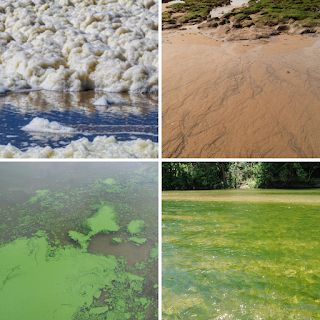
HABs – Say Algae You Later!

Being a Clinton County native, summer notifications of harmful algal blooms (HABs) at local beaches are nothing new. Certain places in our ...